
Email id: info@ijclinmedcasereports.com
Internal Carotid Artery Agenesis: Clinical and Radiological Review of a Rare Anomaly
Neftah Ismail*, Riache Hafsa, El Hassani Nidal, Lahfidi Amal, Echchrif Kettani Najwa, Fikri Meriem, and Touarsa Firdaous
Department of Neuroradiology, Specialty Hospital, Mohammed V University, Rabat, Morocco
Received Date: 01/12/2025; Published Date: 02/01/2026
*Corresponding author: Neftah Ismail, Department of Neuroradiology, Specialty Hospital, Mohammed V University, Rabat, Morocco
Abstract
Internal Carotid Artery agenesis (ICA) is a rare, even exceptional, congenital anomaly of the cerebral vascular system, defined by the complete absence of ICA development during embryonic life. It occurs with an estimated incidence of less than 0.01% in the general population. Often unilateral and asymptomatic due to collateral circulation, it can nevertheless manifest as ischemic symptoms or headaches, or be discovered incidentally during imaging for other indications. Diagnosis is based on imaging, particularly computed tomography (CT) and MR angiography, which show the absence of the ICA and its bony canal. Complications include stroke and intracranial aneurysms.
Although often benign, ACI agenesis requires accurate diagnosis and careful monitoring due to the associated vascular risk.
This article provides a review of the anatomical, clinical, and radiological data related to this malformation.
Keywords: Internal carotid artery; Agenesis; CT angiography
Introduction
The internal carotid artery is a key component of the anterior cerebral circulation. Its embryonic development is linked to the third pair of aortic arches, around the fourth week of gestation [1]. Agenesis, defined as the complete absence of formation of the ICA and its bony canal, is a very rare anomaly (incidence < 0.01%), often asymptomatic but potentially responsible for neurological events.
Prevalence is higher in men in some series, but there is no consensus [2].
Pathophysiology
The ICA normally forms from the third pair of aortic arches and the aortic sac between the third and fifth weeks of gestation. Early interruption of this development results in agenesis, defined by the total absence of the artery and its bony canal in the base of the skull [3]. On the other hand, late regression would result in hypoplasia or aplasia (very thin or threadlike artery, but with preserved bony canal). These distinctions have important diagnostic and prognostic implications.
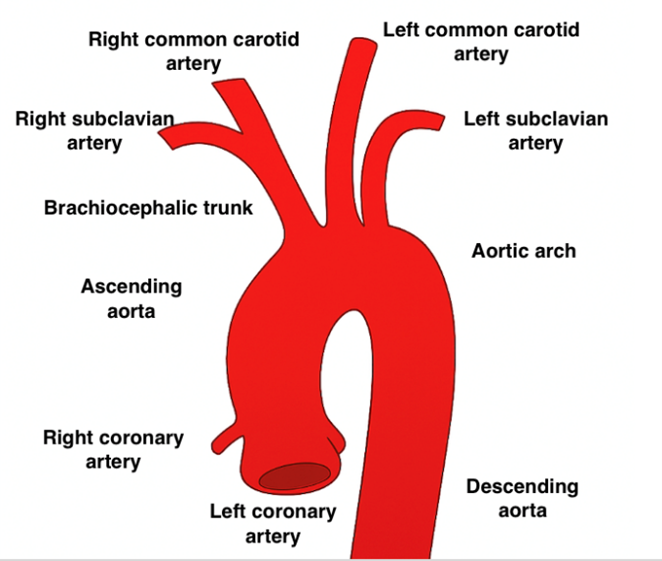
Figure 1: 3rd Aortic Arch.
Clinical Observation
We present the case of a 36-year-old woman who was referred to the medical imaging department at Rabat Specialty Hospital for a CT angiography of the brain following headaches and left hemiparesis.
The CT angiography showed that the right internal carotid artery was not visible from its origin to the cerebral vessels, as well as compensatory dilation of the collateral vessels, provided by the anterior and posterior communicating arteries, which appeared tortuous, dilatation of the contralateral carotid artery, and dilatation of the right hemispheric cortical veins.
The right external carotid artery arises from the right common carotid artery, with no identifiable internal carotid artery.
The CT scan with bone reconstruction showed the absence of the right carotid canal.
Unfortunately, the patient was lost to follow-up, and further complementary diagnostic evaluations could not be performed.
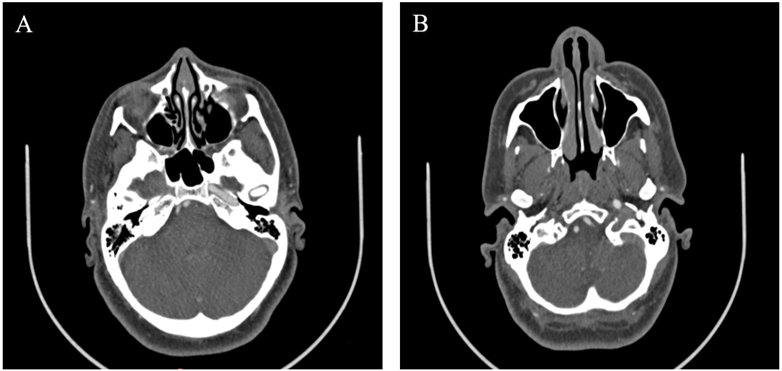
Figure 2: Axial CT scan of the base of the skull showing the absence of the right carotid canal (A). No opacification of the right internal carotid artery (B).
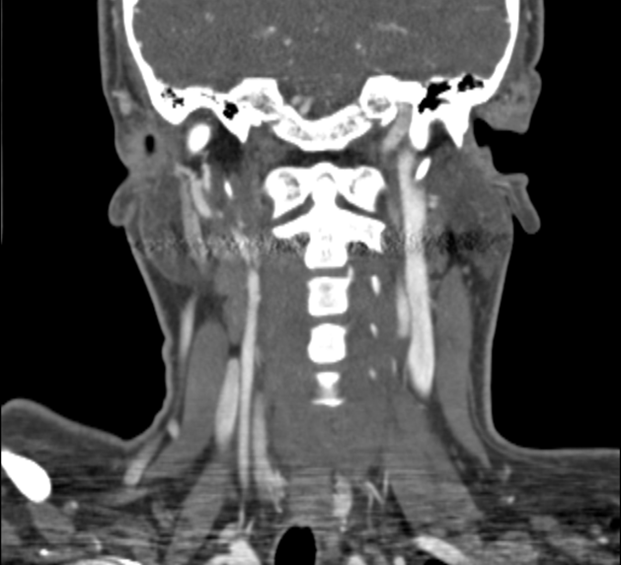
Figure 3: Right external carotid artery arises from the right common carotid artery, with no identifiable internal carotid artery.
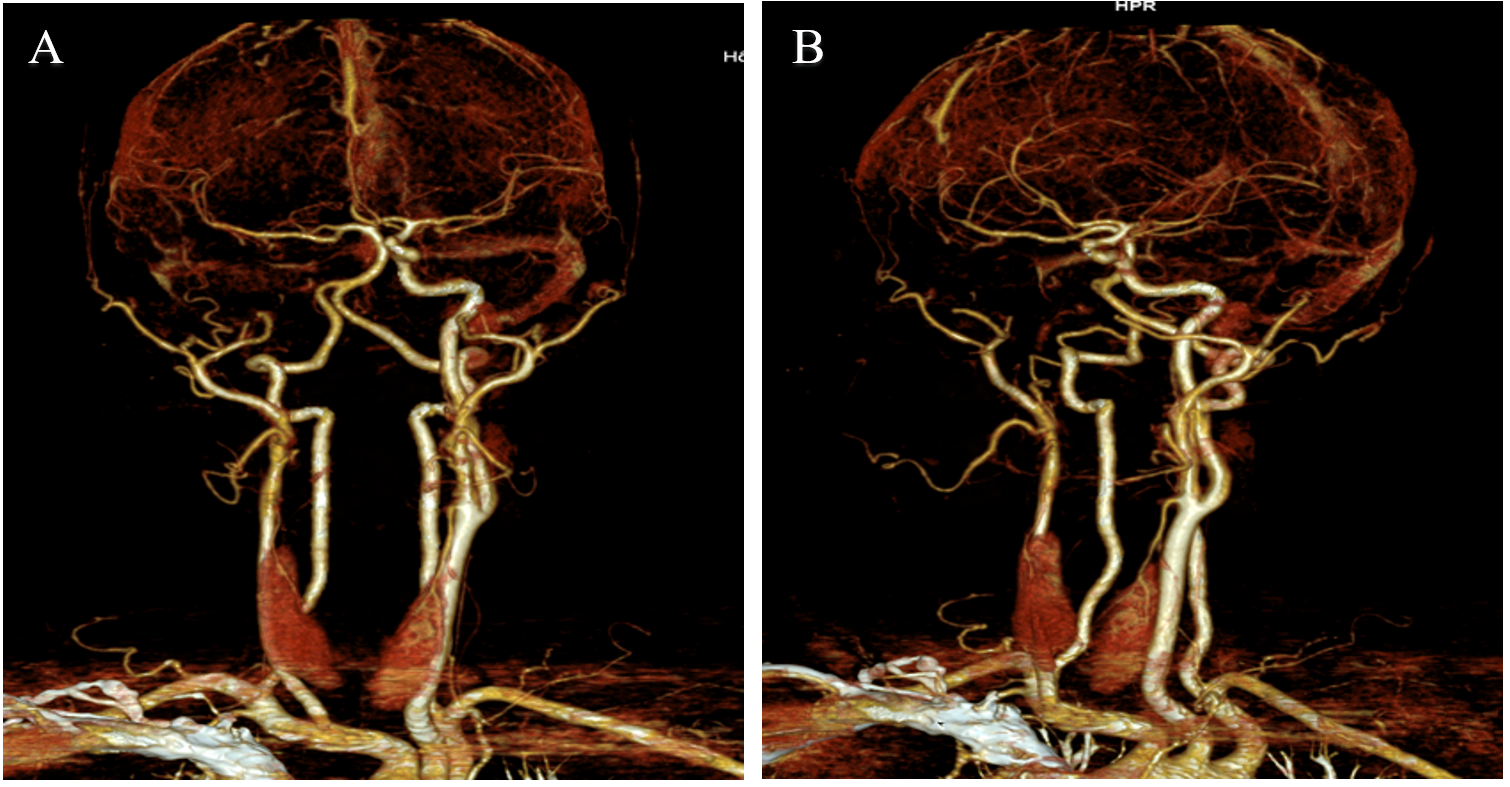
Figure 4: Angio-CT showing the absence of the right internal carotid artery.
Discussion
ACI agenesis is an important differential imaging diagnosis of acquired occlusion, which does not alter the carotid canal. It is generally well tolerated thanks to collateral networks. The major risk remains the formation of intracranial aneurysms on compensatory vessels, probably due to chronic hyperflow [4]. Radiological monitoring is therefore recommended in diagnosed patients. Management is mainly conservative, except in cases of complications requiring neurosurgical or endovascular intervention.
Collateral circulation analysis
- via the contralateral carotid artery through the anterior communicating artery;
- via the vertebral arteries through the posterior communicating artery;
- via the external arteries and meningeal anastomoses.
Clinical manifestations
In most cases, patients are asymptomatic due to effective collateral circulation via the circle of Willis, the vertebral arteries, or the meningeal branches [5]. However, some patients present with neurological symptoms, particularly when the collateral network is incomplete or insufficient, including:
- Transient ischemic attacks (TIAs) or cerebral infarction,
- Chronic headaches,
- Visual disturbances or focal neurological deficits.
There is also a significant association between ACI agenesis and the formation of intracranial aneurysms, observed in 25–35% of cases [6]. These aneurysms, most often located on the anterior or posterior communicating artery, are thought to be promoted by hemodynamic hyperflow in compensatory vessels [7].
Contributions of imaging
Imaging plays a key role in establishing the diagnosis, evaluating collateral pathways, and detecting associated abnormalities:
- CT with bone reconstruction is the examination of choice for visualizing the absence of the carotid canal and analyzing the path of collaterals.
- CT angiography or MR angiography can be used to map intracranial circulation and identify aneurysms or areas of ischemia.
- Dynamic substraction arteriography, although less commonly used today, provides dynamic visualization of circulation and may be indispensable in planning endovascular therapy if a contralateral high-flow aneurysm is present.
Therapeutic and prognostic implications of complications related to agenesis
In most asymptomatic cases, no intervention is necessary. However, recognition of this anomaly has important implications:
- Avoid invasive investigations or unnecessary treatment in cases of misdiagnosis of acute occlusion;
- Initiate clinical and radiological monitoring in patients with associated aneurysms, with possible neurosurgical or endovascular treatment;
- Monitor patients with ischemic symptoms to assess the appropriateness of revascularization.
Some authors recommend systematic screening for intracranial aneurysms by MR angiography in all diagnosed patients, due to the increased risk of rupture [8].
Differential diagnosis
It is essential to distinguish congenital agenesis from acquired occlusion (due to atherosclerosis, dissection, thrombosis, or trauma). In acquired occlusion, the carotid canal in the temporal bone is still present, since embryological formation has taken place. The identification of an absence of the carotid canal on imaging (CT or MRI) is therefore a pathognomonic criterion for agenesis [9].
Conclusion
ICA agenesis is a rare and often asymptomatic congenital anomaly, revealed by modern imaging techniques. Its recognition is essential in order to distinguish this condition from pathological occlusion, anticipate vascular risks, and adapt follow-up care. Screening for associated aneurysms is recommended.
In summary, ICA agenesis is a rare congenital vascular anomaly that is generally benign but potentially associated with serious complications. Its recognition is based on specific radiological criteria, notably the absence of the bony canal. Careful evaluation of collaterals and aneurysms is essential to guide follow-up and prevent major neurological events.
References
- Xu X, Shen H, Ma H, Zhang X, Zhang L, Li R, et al. Cerebrovascular disorders associated with agenesis of the internal carotid artery: Findings on digital subtraction angiography. Frontiers in Surgery, 2022; 9: 953697.
- Perla FM, Carbotta G, Di Nardo D, et al. Agenesis of the internal carotid artery: a family pathology? G Chir, 2017; 38(1): 46-49.
- Kahraman AS, Kahraman B, Özdemir ZM, Doğan M, Kaya M, Gormeli CA, et al. Congenital Agenesis of Right Internal Carotid Artery: A Report of Two Cases. J Belg Soc Radiol, 2016; 100(1): 48.
- Jelloul S, Merzem A, Bounnite I, et al. Internal Carotid Artery Agenesis: A Rare Incidental Finding. SAS J Med, 2023; 9(7): 734-736.
- Hadei SK, Ramezani M, Taherian R. Unilateral Agenesis of the Internal Carotid Artery: A Report of Two Rare Cases. Galen Med J, 2023; 11: 2318.
- Rajesh R, Bosse B, Higley R, et al. Aberrant Internal Carotid Artery: An Unusual Anatomic Variant. Imaging & Intervention, 2022; 2(2): 19-22. DOI: 10.5152/iai.2023.22074.
- Collado E, Bardoczi A, Lumsden AB, Garami Z. Internal Carotid Artery Hypoplasia Misidentified as Internal Carotid Artery Dissection. Tex Heart Inst J, 2024; 20(1): 87-93.
- Nitta N, Tsuji A. Unilateral Rete Mirabile in Multiple Intracranial Arteries with Ipsilateral Agenesis of the Internal Carotid Artery: A Case Report. J Med Case Rep, 2023; 17: 268.
- Usanma Koban B, Koban O. A Rare Encounter in Primary Care: Internal Carotid Artery Agenesis – Case Report. Kırıkkale Üni Tıp Fak Derg, 2024; 26(2): 252-255.