
Email id: info@ijclinmedcasereports.com
The Well-Being of Families affected by Hurricane Katrina in Alabama’s Gulf Coast Counties
Andrew A Zekeri1,* and Lilian U Zekeri2
1Department of Sociology and Psychology, Tuskegee University, USA
2Macon County School System, Notasulga High School, USA
Received Date: 08/10/2025; Published Date: 25/11/2025
*Corresponding author: Andrew A Zekeri, Department of Sociology and Psychology, Tuskegee University, USA
Abstract
On August 29, 2005, Hurricane Katrina made landfall along the coasts of Alabama, Mississippi and Louisiana. The devastation caused by Hurricane Katrina left hundreds of thousands of families without food, water, shelter, clothing and medical supplies. The humanitarian effort after the disaster was tremendous and the outpouring of donations and support were great. As a follow up of previous study [1], the purpose of this paper is to examine the lives and experiences of the families affected by the hurricane Twenty years. The study centers around the area’s recovery process, as told by residents who remained in the aftermath of the deadly natural disaster. The focus group research includes conversations with community leaders, residents involved in rebuilding efforts, and those who experienced Katrina firsthand in order to reflect on what it took, and still takes, to overcome such devastation. Results indicated that the survivors are experiencing large unmet needs for housing and employment. Majority (94%) were African Americans, and 45% had no education beyond high school. Regarding their job situation, 86% were unemployed. About 66% of the respondents said they are not very optimistic about the way things will turn out in the future while 48.4% said they have no faith in their own abilities to rebuild their lives. Many survivors (89%) have no faith that the government will help them rebuild their lives. Many (71.5%) are still very stressful twenty years later. Many of the survivors still struggle with mental problems 20 years after the hurricane and have never felt more helpless.
Keywords: Hurricane Katrina; Survivors; Alabama Gulf Coast Counties; Stressful
Introduction
As an extension of previous research [1], the purpose of this study was to examine the well-being of some families affected by Hurricane Katrina living in Alabama’s Gulf Coast and determine how they are faring almost 20 years after one of the deadliest catastrophes in U.S. history unfolded. The storm resulted in over 1,800 fatalities and approximately $160 billion in damage.
On August 29, 2005, Hurricane Katrina made landfall along the coasts of Alabama, Mississippi and Louisiana. The devastation caused by Hurricane Katrina left hundreds of thousands of families without food, water, shelter, clothing and medical supplies. The humanitarian effort after the disaster was tremendous and the outpouring of donations and support were great. As a follow up of previous study [1], the purpose of this paper is to examine the lives and experiences of the families affected by the hurricane Twenty years.
Previous analyses of this sample [1] showed many of that many of the survivors in Alabama’s Gulp Coast were stressful and do not trust the government to help them rebuild their lives. This brief report is an analysis of a follow-up data collected in 2024 to examine the well-being being and rebuilding efforts of the same sample. Understanding how these survivors are doing years later will help FEMA and other professionals tailor health promotion interventions and rebuilding efforts to the needs of this population. No previous longitudinal research has examined the well-being hurricane survivors in rural Alabama.
Method
Research Setting
The present study is part of a longitudinal research examining the impact of Hurricane Katrina in rural Alabama Counties. The present research is a restudy of resident affected by the hurricane that participated in the 2007-2008 research [1]. The research reported here focuses on all communities in two rural counties in the western part of Alabama that were heavily impacted by Hurricane Katrina. Both were designated disaster areas following Hurricane Katrina by Federal Emergency Management Agency (FEMA).
Data Collection
The study was conducted using qualitative and quantitative methods. Focus groups were utilized for in-depth community study. Second, a self-administered questionnaire was administered to those affected by the hurricane and participated in the previous research.
The questionnaires were distributed and collected via personalized drop-off/pick-up to 118 out of the 123 individuals that participated in studied earlier. The drop-off/pick-up method insures a relatively high response rate [1,2]. Information was collected on these individuals’ characteristics, such as age, sex, race and ethnicity, and education. The questionnaire asked about measures of well-being for each person.
Focus Groups
Focus groups were also conducted in major communities within the two counties with those affected by the hurricane, community residents, and other stakeholders with an interest in the well-being of the community and that of those displaced by the hurricane. These groups were structured to provide more detailed information about economic development strategies, challenges, and hopes of those people displaced. Focus group questions were formed by the questions from the survey.
Ten focus groups (5 group interviews in each county) were conducted. Some of the participants were individuals affected by the hurricane.
Group size ranged from five to ten participants. Each session lasted approximately two hours. Each group was asked to comment on community action and economic development issues since Hurricane Katrina. The authors incorporated a common core of questions concerning economic development, rebuilding efforts, and decision-making issues into all of the interviews. Additionally, various public and quasi-public events, from county government and city council meetings and agency board meetings to annual county fair we attended to gather more information.
Results
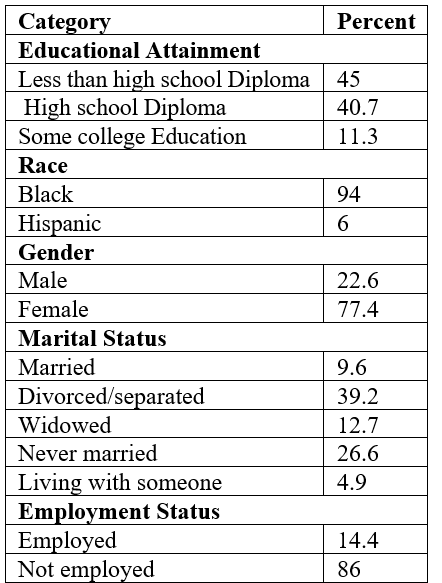
Majority (94%) were African Americans, and 45% had no education beyond high school (Table 1). Only 9.6% were married, and 77.4% were females. Regarding their job situation, 86% were unemployed ten years later.
Table 1: Background Characteristics of Respondent (N=118).
About 66% of the respondents said they are not very optimistic about the way things will turn out in the future (Table 2) while 48.4% said they have no faith in their own abilities to rebuild their lives.
Table 2: Perceptions about rebuilding efforts and trust in government (N=118).
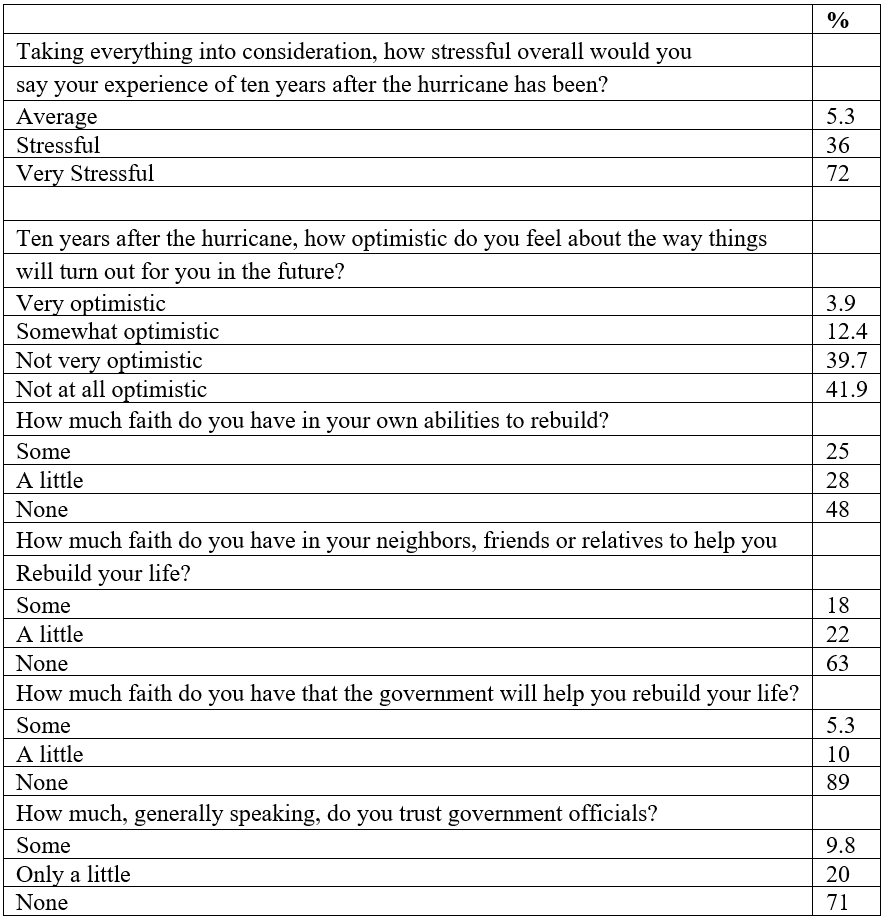
Many survivors (89%) have no faith that the government will help them rebuild their lives. Majority of the survivors (71%) have no trust in government officials to help people in need. Many (71.5%) are still very stressful.
Federal Emergency Management Administration (FEMA) got a 58% and the State government 59.3% percent poor rating from the survivors that dealt with them. The state is poorly rated by
Table 3: Rating of how various people and organizations responded to Hurricane Katrina (N=118).
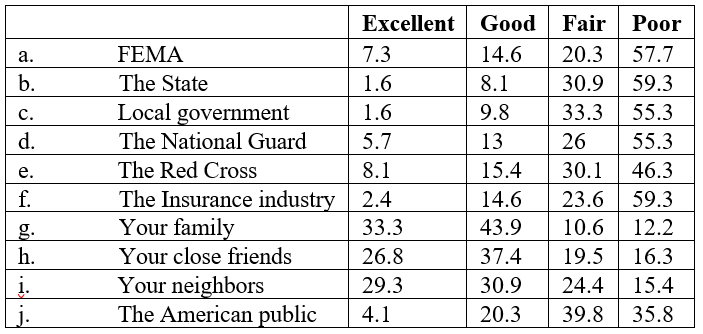
most 90% percent while the insurance industry is poorly rated by almost 85% percent of the respondents. The family, friends, and neighbors were all rated positively by a significant proportion of the survivors ten year later.
Discussion
Many of the hurricane survivors are not very optimistic about the way things will turn out in the future and are very stressful ten years later. These findings provide insights into the precarious situations poor survivors living in rural place like Alabama face despite some improvements in urban areas. Many of the survivors still struggle with mental problems 20 years after the hurricane.
Another interesting finding is that majority of the survivors had no faith in government officials to help them in time of need. Yet, these are the officials that were to help alleviate hurricane related problems. More research is needed to understand the relationships of government officials with hurricane survivors. Such information will have policy implications for EMA and hurricane survivors in rural America.
Conclusion
The purpose of this brief report was to examine the well-being of some families affected by Hurricane Katrina living in rural Alabama and determine how they are faring ten years after the hurricane. Even now, 20 years after the Hurricane Katrina life is still difficult for many of the survivors. Many are still pessimistic about the future. Due to the tragic loss of many things, live can never be made totally whole again. As one survivor put it “it feels like only yesterday the world was ripped by the Hurricane.” As one resident said “I’ve never felt more helpless.”
Most of all, several hundred thousand people processed a trauma that was both personal and collective. That trauma, as well as what people made of it, is the theme of several stories.
The Federal Emergency Management Agency is still the subject of local grumbling for its performance during Katrina. Its leader back in 2005 had no disaster experience, and the agency was slow to deliver supplies or help stranded residents. Field interviews suggest the government is not following their mandates over the years.
Many African American residents saw the hurricane and its aftermath as a parable about racism in America. The counties African American majority disproportionately lived in flood-prone areas. Unsupported stories after the storm cast many African American survivors as looters, and government reconstruction aid appeared to favor white residents.
The brief report has some limitations. To establish generalizability of the results, the study should be replicated in other geographic locations in Mississippi and Louisiana.
References
- Zekeri, Andrew A, Erlene Vaughn. “Rebuilding Lives after Hurricane Katrina: The Experiences of Those Affected in Rural Alabama.” 2010; Pp. 116-124 in N.O. Tackie, R. Zabawa, N. Baharanyi, and W. Hill (eds.). Facing Global Crisis: Local Solutions to Energy, Food and Persistent Poverty. Tuskegee, AL: Tuskegee University.
- Melvin PT, Dillman DA, Baxter R, Lamiman C. Personal Delivery of Mail questionnaires for Household Surveys: A test of Four Retrieval Methods.” Journal of Applied Sociology, 1999; 16(1): 69-88.