
Email id: info@ijclinmedcasereports.com
Mesenteric Dermoid Cyst: A Rare Case and Literature Review
Fariss Dehayni, Asaad El Bakari, Ismail Neftah, Omar Handi, Fatimazzahra Laamrani, Youssef Omor, Rachida Latib, Sanae Amalik
Faculty of Medicine and Pharmacy of Rabat, Morocco
Received Date: 28/10/2025; Published Date: 18/11/2025
*Corresponding author: Dehayni Fariss, Faculty of Medicine and Pharmacy of Rabat, Morocco
Abstract
Mesenteric dermoid cysts are rare congenital tumors classified as mature teratomas. Arising from ectopic germinal tissues within the mesentery, their diagnosis relies primarily on imaging modalities such as Computed Tomography (CT) and Magnetic Resonance Imaging (MRI), which typically reveal a well-defined cystic lesion containing fat, calcifications, and occasionally soft tissue. We report a rare case of a mesenteric dermoid cyst in an adult, highlighting its clinical and radiological features, followed by a literature review.
Introduction
Dermoid cysts are mature cystic teratomas of germ cell origin, most commonly located in the ovaries and, less frequently, in extragonadal sites such as the mediastinum, sacrococcygeal region, and mesentery. Mesenteric localization is exceedingly rare, accounting for less than 1% of all mesenteric tumors [1]. These lesions are often asymptomatic but may present with non-specific abdominal pain, a palpable mass, or complications such as infection, torsion, or rupture. Imaging plays a pivotal role in diagnosis and characterization. This paper presents a mesenteric dermoid cyst case diagnosed through imaging and provides a comprehensive literature review.
Case Presentation
A 45-year-old female presented with painful mass in the right side below the umbilicus, increasing gradually in size, with no history of vomiting, fever, or weight loss. On abdominal examination, an intra-abdominal mobile mass of around 10 cm × 8 cm was palpable in the right flank.
- Ultrasonography revealed an intraabdominal cystic lesion in the flank suggesting an ovarian origin.
CT abdomen scan (64-slice CT scanner) with intravenous contrast showed a heterogeneous mesenteric lesion of size 10 cm × 8 cm × 10 cm with fatty, ossified, calcified, and cystic components within—findings compatible with mesenteric teratoma (Figure 1). MRI: Distinct tissue characterization, with fat appearing hyperintense on T1, fluid on T2, and occasional wall enhancement (Figure 2).
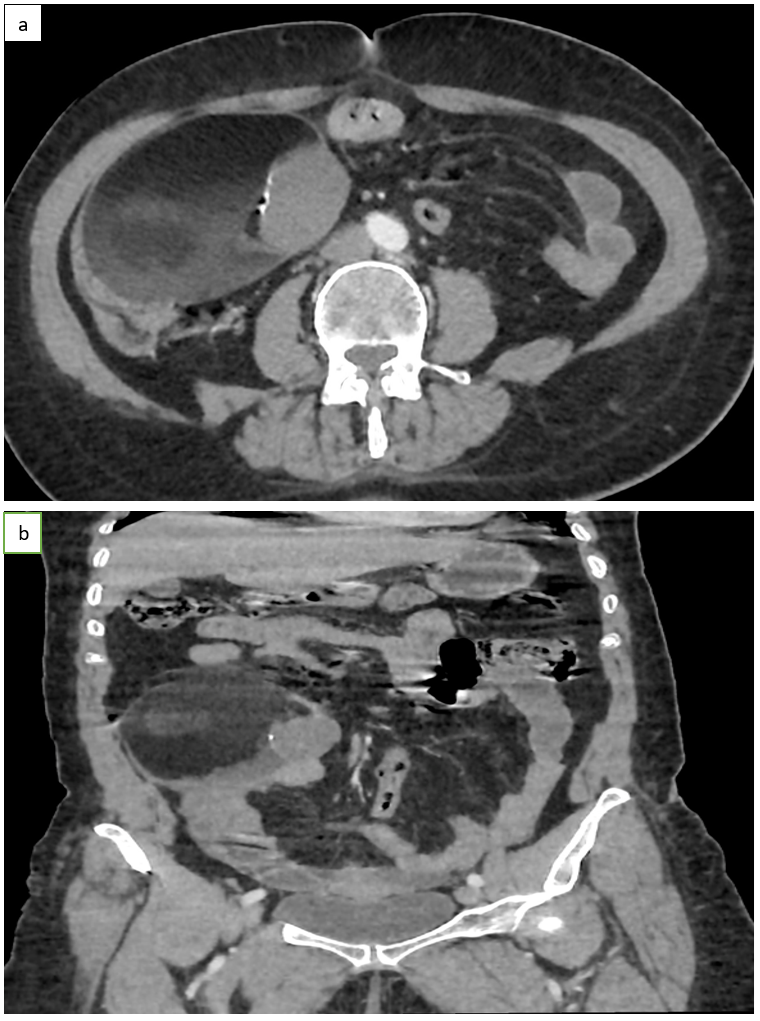
Figure 1: CT abdomen scan with intravenous contrast in axial section (a), with coronal reconstruction (b).
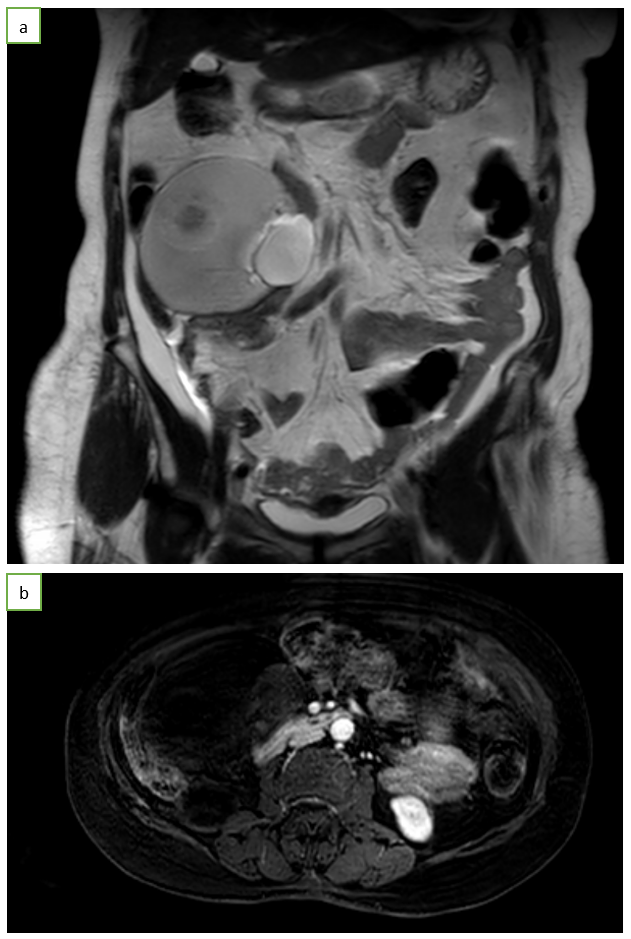
Figure 2: MR abdomen in coronal T1 (a); with intravenous contrast in axial section (b).
Discussion
Pathogenesis and Epidemiology
Mesenteric dermoid cysts, or mature teratomas, comprise tissues from all three embryonic germ layers, predominantly ectodermal elements such as hair, sebum, and keratinized epithelium. Their pathogenesis is attributed to aberrant migration of germ cells during embryogenesis. These lesions are exceptionally rare, with only isolated cases reported in the literature [2].
Clinical Features
Most mesenteric dermoid cysts are incidentally discovered due to their asymptomatic nature. When symptomatic, they may present with diffuse abdominal pain, a palpable mass, or compressive symptoms. Rarely, complications such as infection, torsion, or rupture occur [3,4].
Imaging Findings
- Ultrasound: Heterogeneous cystic mass with echogenic components (fat or calcifications).
- CT: Well-circumscribed lesion containing fat, calcifications (sometimes tooth-like), and possible solid elements. These findings are highly characteristic of dermoid cysts and aid significantly in preoperative diagnosis (Patel et al., 2021).
- MRI: Distinct tissue characterization, with fat appearing hyperintense on T1, fluid on T2, and occasional wall enhancement.
Differential Diagnosis
The differential includes simple mesenteric cysts (lymphangiomas, enteric cysts), pseudocysts, mesenchymal tumors, and hydatid cysts—particularly in endemic regions. The presence of fat and calcifications strongly supports the diagnosis of a dermoid cyst.
Management
Complete surgical excision is the definitive treatment, aiming to prevent complications and confirm histopathology. Laparoscopic approaches are increasingly favored due to reduced morbidity and faster recovery. Prognosis is excellent, with minimal risk of recurrence post-excision.
Conclusion
Mesenteric dermoid cysts are rare entities with distinctive imaging characteristics—fat content, calcifications, and a well-defined cystic structure. Surgical resection remains the gold standard for both diagnosis and treatment. Increased awareness of this condition may improve diagnostic accuracy and therapeutic outcomes.
References
- Matsuoka K, Shibata T, Sasaki K, Yamamoto T. Extraovarian mature cystic teratoma of the mesentery: A case report and review of the literature. Clinical and Experimental Obstetrics & Gynecology, 2011; 38(3): 287–289.
- Yadav N, Mathur A. Mesenteric dermoid cyst in adult: A rare case and review of literature. Asian Journal of Research in Surgery, 2021; 4(1): 24–28.
- Gupta A, Singla S. Mesenteric teratoma in elderly female: A rare case report. International Surgery Journal, 2017; 4(2): 734–736. https://doi.org/10.18203/2349-2902.isj20170496.
- Patel M, Parmar S, Kalathia J. A huge mesenteric teratoma in reproductive age woman: A rare case report. International Journal of Reproduction, Contraception, Obstetrics and Gynecology, 2021; 10(6): 2401–2403. https://doi.org/10.18203/2320-1770.ijrcog20212163.