
Email id: info@ijclinmedcasereports.com
VEMFTherapy for the Regeneration of Stretch Marks Caused by Post-Oncological Therapy
Maurizio Busoni1,* and Luciana Rindi2
1Master's II Degree in Aesthetic Medicine, University of Camerino, Camerino (MC), Italy
2Rindi Medical Office, Florence, Italy
Received Date: 13/08/2025; Published Date: 15/09/2025
*Corresponding author: Maurizio Busoni, Master's II Degree in Aesthetic Medicine, University of Camerino, Camerino (MC), Italy
Abstract
Introduction: Stretch marks are one of the most common skin conditions worldwide. One of the causes of their formation is chemotherapy. There are no specific clinical studies on the incidence, location, and complexity of these lesions. Personal experience has led us to note that these stretch marks are characterized by a width and length far greater than average compared to those caused by puberty or pregnancy, and they significantly impact patients' self-esteem and interpersonal relationships.
Materials and methods: This case report concerns a 33-year-old male patient who, at age 17, was diagnosed with a diencephalic brain tumor. The patient underwent chemotherapy and subsequent radiotherapy. The patient underwent a cycle of fifteen weekly sessions (one session per week for a total of fifteen sessions) of Biodermogenesi®, also known as VEMFtherapy, which is based on the combined use of electromagnetic fields, vacuum and electroporation.
Results: The stretch marks showed a reduction in their size and a tan after sun exposure. An evolution of the hair in the stretched area was also noted.
Conclusion: Despite all the limitations of a case report, we believe that Biodermogenesi can promote the regeneration of stretch marks caused by chemotherapy in the absence of side effects, opening up new therapeutic perspectives.
Keywords: Biodermogenesi; VEMFtherapy; Stretch marks; Striae albae; Regenerative medicine; Chemotherapy
Introduction
Stretch marks are one of the most common skin diseases in the world for which various therapies have been proposed [1]. Although the literature on therapeutic proposals is extremely extensive, there are no specific clinical studies or case histories dedicated to stretch marks arising as a result of chemotherapy. There is no specific data on the incidence, location and complexity of these lesions, nor is there any information available on the average age of the patients when the stretch marks occur. Personal experiences have led us to note a dozen cases, always burdened by stretch marks spread over large parts of the body, all characterized by width and length well above average compared to what we could call "physiological" stretch marks, or due to puberty or pregnancy. In three of the cases related to our personal experiences, stretch marks have arisen in patients under 25 years of age, significantly affecting their self-esteem and interpersonal relationships.
Materials and Methods
The present case history is about a 33-year-old male patient who, at the age of 17, was diagnosed with a brain tumor mass at diencephalic level that, due to a diagnostic error (wrong biopsy), was not treated promptly. Due to a worsening of the symptoms, the patient underwent emergency chemotherapy and subsequent radiotherapy.
The stretch marks have appeared since the first chemotherapy treatment with cisplatin and, at the same time, the patient recorded a rapid weight gain of about 10 kg due to an inadequate treatment of diabetes insipidus, symptom of the onset of cancer.
The stretch marks are between twelve and twenty centimeters long and more than two centimeters wide, they affect the axillary region, the lower part of the abdomen and cover the lower limbs entirely. All striae are also characterized by significant atrophy and have a lower density to the touch than the surrounding healthy tissue.
Five months after the end of the radiotherapy treatment – with the resolution of the tumor – some stretch marks were treated with 20% Trichloracetic acid’s peeling with improvement of the clinical picture. Then, the treatment was extended to the whole body with improvements represented by the reduction of the depth and fragmentation of the stretch marks that appear crossed by "bridges" of healthy tissue.
Treatment was then interrupted due to poor patient compliance.
After fourteen years from peeling therapy, the patient underwent a cycle of weekly sessions with Biodermogenesi® for fifteen weeks, also called VEMFtherapy, based on the use of the Bi-one® LifeTouchTherapy medical device (Expo Italia Srl, Firenze, Italy).
VEMFtherapy works by simultaneously producing electromagnetic fields and vacuum, whose frequencies and intensities are controlled thanks to an artificial intelligence system that modulates its delivery in real time. In the specific field of stretch marks, vacuum is effective in reactivating the skin microcirculatory system [2,3] while the electromagnetic field interacts on the sodium and potassium pump through the specific hydroelectric pores present on the cell membranes [4] increasing the supply of nutritional elements and oxygen and detoxifying the cells, thus facilitating the reactivation of regenerative and reparative phenomena [5] on the basis of the Van’t Hoff Law.
The patient has signed the informed consent and has given his consent to the use of his data for the purposes of this article. The text has been drawn up in accordance with the provisions of the Helsinki Protocol and its consequential amendments, as well as those of MEDDEV 2.7.1 fourth edition.
On an anecdotal level, it is correct to report that our expectations were modest because we had no previous experience in the treatment of post-oncological stretch marks, especially taking into account their size and dating and, consequently, we did not foresee specific methods for the evaluation of the results.
Only a few months after finishing the therapies we found unexpected results and, therefore, we decided to write this article supporting it with photographic documentation.
Results
To document the results obtained, we identified an area of the abdomen where the most critical stretch marks were present for various reasons. The stretch marks were particularly wide and long and showed very little healthy tissue between them, poor compactness to the touch and had acquired an opaque color over time.
In order to properly identify the treated area, we highlighted in light blue the bridges of healthy tissue that crossed the striae, identified as "A", "B" and "C" (see figure 1b) and then we compared images taken before the treatment cycle and six months after the last session (see figures 2a and 2b).
The comparative analysis of images shows clear improvements in skin tissue. The first aspect that we have noticed is given by the evident reduction of the length of the stretch marks and, in this sense, we appreciate the reduced extension presents above the "C" bridge as a result of the therapies. At the same time, the other stretch marks are also less extensive than T0.
In addition to the size reduction, we also found that the stretch marks have tanned with sun exposure, while the skin tissue is generally more compact and elastic and the emptying that characterized the striae at T0 has been drastically reduced. At the same time, we noticed a greater amount of hair present within the stretch marks with the configuration of mature hair.
During the sessions, no side effects were observed, and the level of comfort expressed by the patient was extremely high, equal to 8 on a scale from 0 to 10.
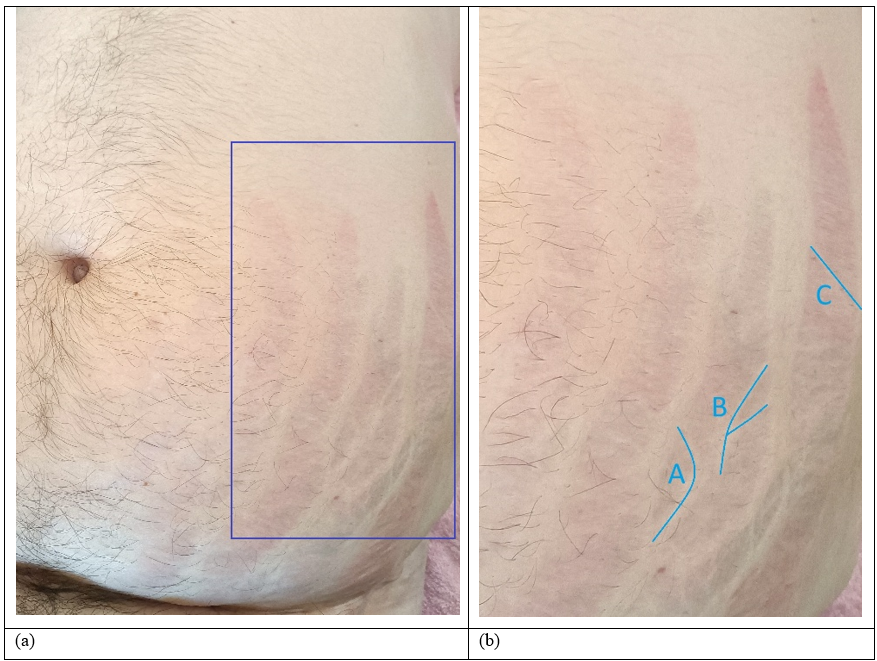
Figure 1: Figure 1a shows the entire left side of the patient’s abdomen with a “box” indicating the specific area being examined. In figure 1b it is possible to see the details of some “bridges” of healthy tissue crossing the stretch marks at points "A", "B" and "C", drawing a texture that allows the identification of the stretch marks.
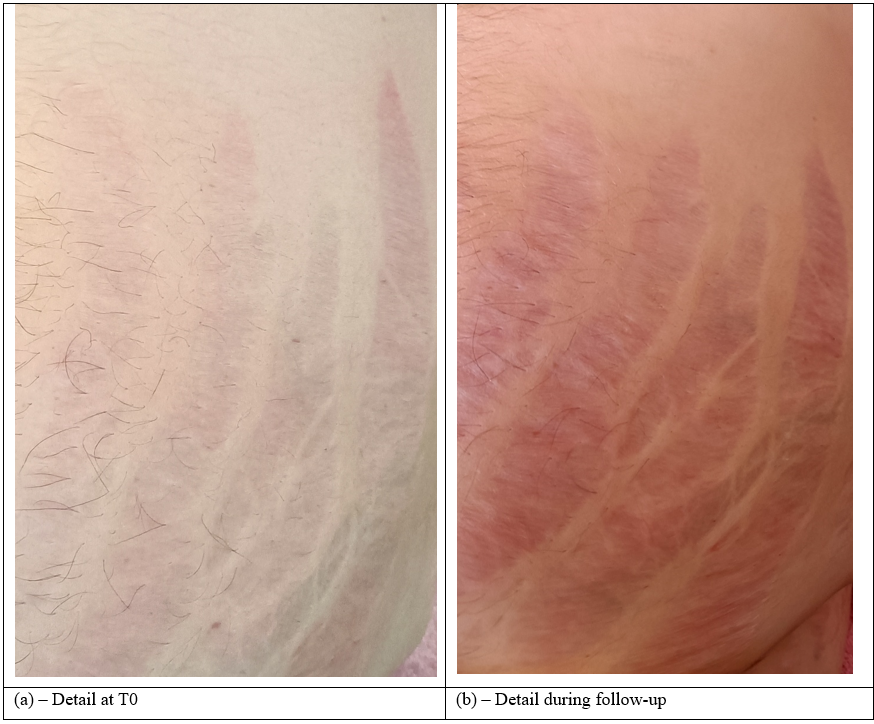
Figure 2: Analyzing the two pictures, some tissue reactions were recorded during the follow-up performed six months after the end of the sessions. The striae have reduced their length, as is evident by reference to the upper extremities of the "A" and "B" bridges of the central vertex and the "C" bridge of the right vertex (see figure 1a). The most obvious aspect is given by the fact that the stretch marks exposed to the sun have tanned reaching a colour similar to that of the adjacent intact tissue attenuating the evidence.
Discussion
The total lack of previous information in the literature regarding stretch marks due to chemotherapy has made us start the therapeutic path with limited hopes of effective improvement, also considering the extreme size of the striae, their density and their dating. Only during the follow-up performed six months after the end of the sessions we realized the effective improvement of the stretch marks, also appreciated by the patient.
Analyzing the results obtained, we note that these are confirmed in the literature related to Biodermogenesi®, otherwise known as VEMFtherapy. The perception of greater density and compactness of the striped tissue is confirmed by Scarano et al [6]. Who have shown that the stretch marks reorganize and fill themselves thanks to the multiplication of elastic fibers and collagen? As regards to the ability of stretch marks to tan, it is confirmed by Scarano [6] et al.’s experience that, thanks to histochemistry, the production of new melanocytes within the tissue is found, while Artigiani et al [7] and Bacci et al [8] have demonstrated with biopsies performed on twenty patients the reorganization of the basal membrane, restoring the correct wave shape and the clear separation between epidermis and dermis. Tanning of stretch marks treated with VEMFtherapy has also been intuitively demonstrated by Alberti et al [9] Veronese et al [10] and Roberto et al [11] as more than seventy patients treated have found the ability of stretch marks to tan like the surrounding skin tissue.
Hair regrowth within the stretch marks confirms what was reported by Marafioti et al [12] in the treatment of large burn scars with VEMFtherapy, where hair growth was found on ultra decennial III degree burn scars. It is interesting to note that Biodermogenesi® has already allowed the restoration of other skin attachments such as sebaceous glands on patients with chemical burns resulting in skin transplantation dated over ten years [13].
The results obtained lead us to confirm the efficacy already documented by VEMFtherapy with previous published studies, which find further validation from the scientific bibliography related to the two specific forms of energy adopted.
The vacuum has both a direct action on skin microcirculation [2,3] and an indirect action in skin regeneration through mechanotransduction, that is "the processes whereby cells convert physiological mechanical stimuli into biochemical responses" [14,15].
The electromagnetic fields have shown an important action in regenerative medicine by increasing cell proliferation and generation of mesenchymal cells [16-18]. Further studies have shown that tissue regeneration continues for a long time after exposure to electromagnetic fields [19].
Conclusion
Certainly, despite the encouraging results obtained, this case series does not allow us to affirm with certainty that VEMFtherapy is effective, safe, and, above all, replicable in the treatment of stretch marks following chemotherapy. However, it does allow for the launch of a study involving a larger number of patients to confirm its efficacy on a large scale. The results and supporting literature suggest further research in this direction.
Distribution of tasks: L. Rindi performed the therapies; M. Busoni developed the therapeutic protocol and wrote the article.
Conflict of interest: M. Busoni is part of the board of directors of Expo Italia Srl, the other authors have no conflict of interest. None of the authors has received remuneration for the activity covered by this article.
References
- Adam Hague, Ardeshir Bayat. Therapeutic targets in the management of striae distensae: A systematic review. J Am Acad Dermatol, 2017; 77(3): 559-568 http://dx.doi.org/10.1016/j.jaad.2017.02.048.
- Moortgat P, Anthonissen M, Meirte J, Van Daele U, Maertens K. The physical and physiological effects of vacuum massage on the different skin layers: a current status of the literature – Burns & Trauma, 2016; 4: 34.
- Meirte J, Moortgat P, Anthonissen M, Maertens K, Lafaire C, De Cuyper L, et al. Short-term effects of vacuum massage on epidermal and dermal thickness and density in burn scars: an experimental study – Burns & Trauma, 2016; 4: 27.
- Singer SJ, Nicolson NL. The fluid mosaic model of the structure of cell membranes. Science, 1972; 175(4023): 720-731. doi: 10.1126/science.175.4023.720.
- https://www.nobelprize.org/prizes/chemistry/1901/hoff/facts/
- Scarano A, Sbarbati A, Amore R, Iorio EL, Ferraro G, Lorusso F, et al. A New Treatment for Stretch Marks and Skin Ptosis with Electromagnetic Fields and Negative Pressure: A Clinical and Histological Study. J Cutan Aesthet Surg, 2021; 14(2): 222–228.
- Artigiani A, Cervadoro G, Loggini B, Paolicchi A. Biodermogenesi®: la soluzione non invasiva nel trattamento delle smagliature. La Medicina Estetica, 2012; 1: 41-49.
- Bacci PA, Alberti G, Amuso D, Artigiani A, Benitez Roig V, Di Nardo V, et al. The synergy between vacuum and electromagnetic fields in the treatment of striae distensae: retrospective study on 917 patients with clinical and histological case records A possible treatment for striae distensae. Journal of Applied Cosmetology, 2021; 39(1): 43-54.
- Alberti G, Laura S. Treatment of stretch marks aged more than twenty years with the synergy of electromagnetic field and vacuum. Clinical case studies and subsequent follow up. Aesthetic Medicine, 2019; 5(1): 14-21.
- Veronese S, Bacci PA, Garcia Gimenez V, Canel Micheloud CC, Haro García NL, Sbarbati. A. V-EMF therapy: A new painless and completely noninvasive treatment for striae gravidarum. J Cosmet Dermatol, 2024; 00: 1-8. doi:10.1111/jocd.16220.
- Marafioti S, Veronese S, Pecorella C, Tavernese CF, Costantino S, Busoni M, et al. Electromagnetic Fields, Electrical Stimulation, and Vacuum Simultaneously Applied for Major Burn Scars. Bioengineering, 2025; 12: 179. https://doi.org/10.3390/bioengineering12020179.
- Veronese S, Brunetti B, Minichino AM, Sbarbati A. Vacuum and Electromagnetic Fields Treatment to Regenerate a Diffuse Mature Facial Scar Caused by Sulfuric Acid Assault. Bioengineering (Basel), 2022; 9(12): 799. doi: 10.3390/bioengineering9120799.
- Lee RT, Yamamoto C, Feng Y, Potter-Perigo S, Briggs WH, Landschulzi KT, et al. Mechanical Strain Induces Specific Changes in the Synthesis and Organization of Proteoglycans by Vascular Smooth Muscle Cells – The Journal of Biological Chemistry, 2001; 276(17): 13847–13851.
- Khan KM, Scott A. Mechanotherapy: how physical therapists’ prescription of exercise promotes tissue repair – Br J Sports Med, 2009; 43: 247–251.
- Sun LY, Hsieh DK, Yu TC, et al., Effect of pulsed electromagnetic field on the proliferation and differentiation potential of human bone marrow mesenchymal stem cells. Bioelectromagnetics, 2009 ; 30(4): 251-260. https://doi.org/10.1002/bem.20472.
- Zhang MS, Li XP, Bai LM, et al. Effects of low frequency electromagnetic field on proliferation of human epidermal stem cells: an in vitro study. Bioelectromagnetics, 2013; 34(1):74-80.
- Fan WX, Qian FH, Ma QL, et al. 50 Hz electromagnetic field exposure promotes proliferation and cytokine production of bone marrow mesenchymal stem cells. Int J Clin Exp Med, 2015; 8(5): 7394-7404.
- Tu C, Xiao YF, Ma YZ, et al., The legacy effects of electromagnetic fields on bone marrow mesenchymal stem cell self-renewal and multiple differentiation potential. Stem Cell Res Ther, 2018; 9: 215.