
Email id: info@ijclinmedcasereports.com
Permeable Bicervical Uterus: Two Full-Term Pregnancies Requiring Two Caesarean Sections
Bassir G, Maali I, Gotni A, Assal A, Bensouda M, Jalal M, Lamrissi A and Samouh N
Hôpital Mère-Enfant Abderrahim HAROUCHI, Casablanca, Marocco
Received Date: 18/07/2025; Published Date: 25/08/2025
*Corresponding author: Bassir G, Hôpital Mère-Enfant Abderrahim HAROUCHI, Casablanca, Marocco
Abstract
The permeable bicervical uterus is a relatively rare uterine malformation, often diagnosed incidentally during an examination performed for another purpose. It is asymptomatic, and during pregnancy, this malformation may go undetected if no prenatal monitoring has been carried out. We report two cases of permeable bicervical uterus discovered incidentally during caesarean section. The interest of this case is to show the obstetrical prognosis in fertile women carrying this uterine malformation.
Introduction
Most congenital malformations are detectable at birth, while others are diagnosed during the ante-natal period, and still others during puberty or adulthood. The latter often go unnoticed for a long time, and are only discovered by chance. These include uterine malformations, in particular bicervical uteri, which may be discovered on imaging or during abdominopelvic surgery for another reason. We report here two cases of permeable bicervical uterus discovered incidentally during caesarean section. The interest of this case is to show the obstetrical prognosis in fertile women with this uterine malformation.
Patients and Observation
The first case concerns a 21-year-old parturient, primigravida primiparous, with no particular pathological history, carrying a pregnancy of 40 weeks of amenorrhea and 2 days. She had not attended any antenatal clinic. Her general condition was good and vital signs within normal limits. Obstetrical examination revealed a uterine height of 34 centimetres, fetal heart sounds perceived and counted at 130 beats per minute, cervix closed outside of labour, breech presentation, vaginal touch revealed an uncloistered vagina and two cervical orifices, one eccentric to the right and the other central. A caesarean section was indicated and resulted in the extraction of a 2700-gram female newborn with an excellent Apgar score.
The intraoperative findings, after fetal extraction, reveal two distinct and totally separate hemi-uteri, as well as two isthmuses and two cervixes. The first, on the left, is gravid with a well-formed lower segment ; the second, on the right, is non-gravid, enlarged and globular, comparable to a pregnancy of 8 to 10 weeks' amenorrhea with adnexa on the right side (Figure 1, 2). Intraoperatively, two hysterometers were introduced, one through a cervix whose opening allowed only the pulp of a finger to pass through, and the other through a cervix dilated to 1 cm. The first was introduced in a straight direction at a depth of 13 centimetres, and the second was visible through the hysterotomy incision. The post-operative course was straightforward, and the patient was discharged on day 3 in good clinical condition. A radiological and ultrasound exploration in search of associated renal malformations was scheduled at a later date.
The second case concerns a 32-year-old parturient, primigravida primiparous, with no particular pathological history, carrying a pregnancy of 39 weeks' amenorrhea and 2 days, who had been transferred to us for dynamic dystocia of the hyperkinetic type, resistant to treatment. Her general condition was good and vital signs within normal limits. Obstetrical examination revealed a uterine height of 35 centimetres, fetal heart sounds perceived and counted at 128 beats per minute, uterine contractions of long duration and close interval, cervical dilatation of 7 centimetres, complete cervical effacement, absence of membranes, decompressed breech presentation with non-engaged buttocks. In addition, the vaginal examination revealed a non-partitioned vagina and two cervical orifices, one of which was eccentric to the right and the other central, effaced and dilated to 7 centimetres. An emergency caesarean section was indicated, allowing extraction of a 3400-gram male newborn with an excellent Apgar score. The intraoperative findings, after fetal extraction, reveals two hemi-uteri with two bodies between which the posterior bladder wall insinuates (bladder V sign), each with adnexa on one side only, as well as two isthmuses and two necks. The first, on the right, is gravid with a well-formed lower segment; the second, on the right, is non-gravid, increased in volume and globular, comparable to a pregnancy of 8 to 10 weeks' amenorrhea, with adnexa on the right side (Figure 1, 2). Intraoperatively, two hysterometers were introduced, one through a cervix whose opening allowed only the pulp of a finger to pass through, and the other through a cervix dilated to 7 centimetres. The first was introduced and headed straight down to a depth of 13 centimetres, while the second was visible through the hysterotomy incision. The post-operative course was straightforward, and the patient was discharged on day 7 in good clinical condition.
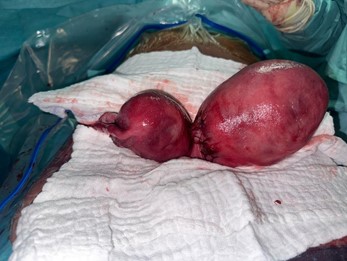
Figure 1: Left hemi-uterus after fetal extraction.

Figure 2: Intraoperative findings after fetal extraction.
Discussion
The prevalence of congenital uterine anomalies in the population is estimated at between 1% and 4%, depending on the study [1-3]. It is difficult to determine the exact prevalence, as many of these malformations are asymptomatic and seem to be diagnosed more frequently in patients followed for infertility or recurrent miscarriage. Permeable bicervical uteri, or “didelphic uteri” as they are known in the English-speaking world, are fairly rare, and their frequency varies from 11 to 24.2% of all major uterine malformations, depending on the author [1,4-6]. Embryologically, they are due to a defect in the complete fusion of the Müllerian ducts between the 10th and 13th weeks of pregnancy, resulting in the formation of two non-communicating uterine cavities [2]. A vaginal septum is absent in 25% of cases, as in our observation. According to the classification of the American Fertility Society, bicervical uteri correspond to class III. They are accompanied by unilateral urinary malformations such as agenesis in 10 to 50% of cases, cases [3,7]. 2 comprising two bodies between which the bladder wall insinuates itself Page number not for citation purposes Clinically speaking, in many cases, bicervical uteri remain asymptomatic, especially if they are permeable; the diagnosis is only made incidentally during an examination carried out for another purpose. Thus, the diagnosis of a bicervical bicorneal uterus may be made during an initial pregnancy check-up, or during vaginal delivery, when the presence of a vaginal septum or two previously unrecognized cervixes is discovered [3]. Given its rarity, the patient's age and multiparity, it was surprising that this anomaly had never been detected during prenatal monitoring of previous pregnancies. From an obstetrical point of view, uterine malformations are generally associated with a large number of dystopic presentations, and among these, a breech presentation is found in 23 to 61% of cases of uterine malformation [1]; as for mode of delivery, the frequency of caesarean section is significantly higher in cases of uterine malformation, with rates ranging from 27.5 to 83% depending on the study. authors [1,5,8], this can be explained by the fact that uterine malformations are often associated with dystocic presentations, but they are also associated with a greater frequency of labor anomalies in around 50% of cases, of the cervical and dynamic dystocies type [1]. In the case of our patient, no obstetric complications had previously been observed in any of her five previous deliveries. It was only during her sixth pregnancy that she developed hyperkinesia that was resistant to treatment, resulting in a caesarean section. Certains types of uterine malformation have consequences for reproductive life, and require surgery to restore continuity. But in the case of a permeable bicervical uterus, surgery to reunify the two hemi-uteri is reserved for patients with a very poor obstetrical prognosis.
Conclusion
Uterine malformations are common in the general population, but the reproductive consequences vary according to the type of malformation. Given our patient?s obstetrical history and identity, we can say that the obstetrical prognosis in women with bicornuate bicervical permeable uteri often appears to be very good.
References
- Savey L, Le Tohic A. Malformations utérines. EMC - Gynécologie, 2003; 123-A-10.
- Ardaens Y, Levaillant JM, Bady J, Coquel P. Malformations utérines et du tractus génital féminin. EMC - Radiodiagnostic - Urologie-Gynécologie, 2006; 34-620-D-10.
- Rossier MC, Bays V, Vial Y, Achtari C. Les malformationsutérines : diagnostic, pronostic et prise en charge en 2008. Rev Med Suisse, 2008; 4(176): 2253-2254, 2256-2258, 2260 passim.
- Grimbizis GF, Camus M, Tarlatzis BC, Bontis JN, Devroey P. Clinical implications of uterine malformations and hysteroscopic treatment results. Human Reproduction Update, 2001; 7(1): 161-174.
- Zhang Yan, Zhao Yang-yu, Qiao Jie. Obstetric outcome of women with uterine anomalies in China. Chin Med J, 2010; 123(4): 418-422.
- Nahum GG. Uterine anomalies. How common are they, and what is their distribution among subtypes? J Reprod Med, 1998; 43(10): 877-887.
- Saravelos SH, Cocksedge KA, Tin-Chiu Li. Prevalence and diagnosis of congenital uterine anomalies in women with reproductive failure: a critical appraisal. Hum Reprod Update, 2008; 14(5): 415-429.
- Shuiqing M, Xuming B, Jinghe L. Pregnancy and its outcome in women with malformed uterus. Chin Med Sci J, 2002; 17(4): 242-245.