
Email id: info@ijclinmedcasereports.com
The Hepatic Hot Spot Sign: A Radiologic Clue to Thoracic Venous Obstruction
Kaouthar Sfar*, Laamrani Fatima Ezzahra, Youssef Omor, Rachida Latib and Sanae Amalik
Radiology Department, National Institute of Oncology Mohamed V University, Rabat, Morocco
Received Date: 05/07/2025; Published Date: 21/08/2025
*Corresponding author: Kaouthar Sfar, Radiology Department, National Institute of Oncology Mohamed V University, Rabat, Morocco
The focal hepatic hot spot sign, first described by Ishikawa in 1983, is a radiological finding typically seen on technetium-99m sulfur colloid scintigraphy or contrast-enhanced CT scans [1]. It represents a focal and intense enhancement of segment IV of the liver, most commonly observed during the arterial or early portal phase [1,2] (Figure). This enhancement is the result of portosystemic venous shunting that develops when the superior vena cava (SVC) is obstructed, causing venous blood—and thus contrast—to be diverted through collateral pathways. These collateral pathways include the internal thoracic veins, superior and inferior epigastric veins, and the paraumbilical veins—notably the veins of Sappey—which ultimately connect to peripheral branches of the left portal vein, particularly within segment IV. This shunt leads to focally increased hepatic blood flow, creating the appearance of a “hot spot” [1-3].
The hot spot sign is most frequently associated with SVC syndrome, commonly caused by thoracic malignancies such as lung carcinoma and lymphoma, but it has also been reported in other conditions like Budd-Chiari syndrome, fibrosing mediastinitis, Behçet’s disease, and even luetic aneurysms [2].
It is essential not to confuse this sign with true hepatic lesions. Conditions such as hemangioma, hepatocellular carcinoma, and focal nodular hyperplasia can also produce focal enhancement in segment IV, especially near the falciform ligament, potentially mimicking the hot spot sign. However, unlike these true lesions, the hot spot sign is transient, hemodynamic in nature, and resolves when the underlying venous obstruction is treated. Its presence should prompt further imaging, particularly of the thorax, to identify and manage the underlying cause of SVC obstruction [3].
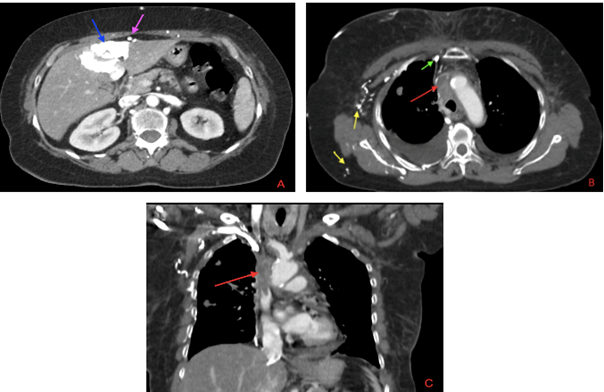
Figure: Contrast-enhanced chest CT with abdominal images in a patient under follow-up for invasive ductal breast carcinoma, presenting to the emergency department with "cape-like" upper body edema, demonstrating a hot spot sign secondary to superior vena cava (SVC) obstruction.
(A) Axial image shows an intense, wedge-shaped enhancement in the quadrate lobe of the liver during the late arterial phase, consistent with the focal hepatic hot spot sign (blue arrow), along with dilated paraumbilical veins located anterior to the left hepatic lobe (pink arrow).
(B) Axial image and (C) coronal image demonstrate right hilar and mediastinal lymphadenopathy invading and occluding the SVC, leading to the development of collateral venous circulation (yellow arrow), with dilatation of the internal thoracic vein (green arrow).
References
- Mohamed DA, Retal H, Onka B, Latib R, Omor Y. Focal Hepatic Hot Spot Sign. Austin J Radiol, 2021; 8(6): 1147.
- Gervaise A, Junca-Laplace C, Pernin M, Darbois H, Portron Y, Lapierre M. Signe du « Hot spot ». Feuillets de radiologie, 2011; 51(3): 162-163.
- Vivek Virmani, Anupam Lai, Chirag K. Ahuja, Niranjan Khandelwal,The CT Quadrate lobe hot spot sign,Annals of Hepatology, 2010; 9(3): Pages 296-298.