
Email id: info@ijclinmedcasereports.com
Cervical Trauma Causing a False Aneurysm of Subclavian Artery in Child
Jiber H1,*, Dabachi H1, Elyoubi S1, Naouli H1, Ouadnouni Y2 and Bouarhroum A1
1Department of vascular surgery, Faculty of medicine, pharmacy and dental medicine, Sidi Mohamed Ben Abdallah University, CHU Hassan II, Fez, Morocco
2Department of Thoracic surgery, Faculty of medicine, pharmacy and dental medicine, Sidi Mohamed Ben Abdallah University, CHU Hassan II, Fez, Morocco
Received Date: 15/06/2025; Published Date: 23/07/2025
*Corresponding author: Hamid Jiber, Faculty of medicine, pharmacy and dental medicine - Sidi Mohamed Ben Abdallah University, BP 1893 – km 2.200, Route Sidi Harazem, Fez, Morocco
Abstract
Post-traumatic false aneurysms of the subclavian artery (SCA) are rare; their occurrence in the context of a cervical wound is even rarer, especially in children. Rarely suspected clinically, it is a CT-scan and/or Angiography that confirms a diagnosis. We report the case of an 11-year-old child who suffered a cervical wound resulting in a false aneurysm of the right SCA, successfully treated surgically.
Keywords: False aneurysm; Subclavian artery; Child; Surgery
Introduction
Traumatic SCA injuries are reported in less than 5% of all traumatic arterial injury. Injuries are associated with high morbidity and mortality [1]. Post traumatic SCA pseudoaneurysm is even rarer and only account for 1–2% of all vascular injuries but mortality is still high due to the risk of rupture, thrombosis and thromboembolism if the pseudoaneurysm is left untreated [2].
Symptoms are determined by the aneurysm site and size. we used CT angiogram and/or angiography to confirm the diagnosis, to define its characteristics, and feasibility of surgical or endovascular approach [3].
We report the case of 11-year-old child who suffered a cervical wound resulting in a false aneurysm of the right SCA, successfully treated surgically.
Case Report
A 11-year-old boy, who presented to the emergency service with a right cervical wound secondary to a scissor. Clinical examination found a conscious child, hemodynamically and respiratory stable, correct blood pressure, apyretic, normo-colored conjunctiva. Cervical examination found a punctiform penetrating cervical wound, no active bleeding. Cardiac and respiratory examinations were normal, with no clinical signs of pleural effusion.
CT scan showed a hematoma in the right cervix and mediastinum, with individualization of extravasation from the right SCA (Figure 1).
Angiography showed a false aneurysm of the right SCA, immediately after the origin of the right carotid artery (Figure 2).
The decision was to perform open surgery in collaboration with thoracic surgeons. The child was admitted to the operating room: After monitoring and conditioning, the child was installed in dorsal decubitus, under general anesthesia: After a mini-sternotomy approach combined with a right infraclavicular incision, primary control of the brachiocephalic arterial trunk and the right common carotid artery. The exploration showed a false aneurysm of the SCA, with a breach near the origin of the common carotid artery (Figure 3). After general heparinization, clamping of the brachiocephalic arterial trunk, the common carotid artery and the distal SCA, we perform a closure of the breach with separate stitches of 5/0 prolene (Figure 4).
The immediate postoperative clinical and biological follow-up was simple. The child discharged after 4 days in hospital.
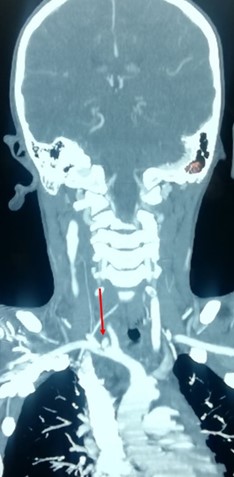
Figure 1: Abdominal CT scan showing the extravasation from the right subclavian artery (arrow).
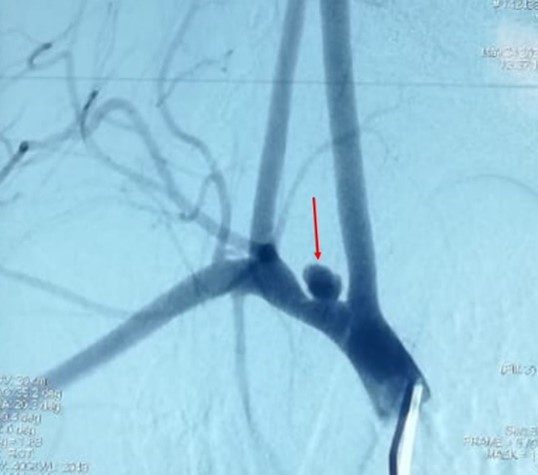
Figure 2: Angiography showed a false aneurysm of the right SCA (arrow).

Figure 3: Intraoperative photograph showing the breach of SCA near the origin of the common carotid artery (arrow).
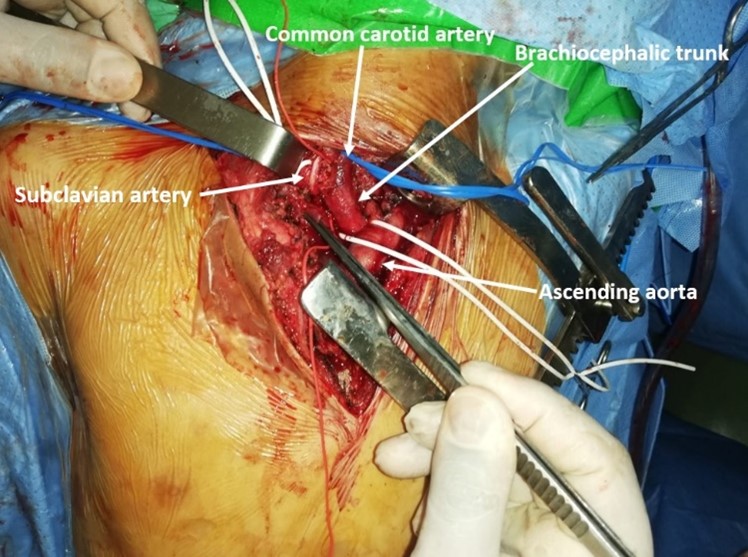
Figure 4: Intraoperative photograph: final result after closure of the breach with prolene.
Discussion
Traumatic SCA injuries are reported in less than 5% of all traumatic arterial injury, less than 2% in penetrating injuries [1,3], or it occurs mainly as a result of central venous catheterization accidentally damaging the artery [4]. It can cause hemorrhage with a life-threatening, limb ischemia and false aneurysm. In child, there are only many cases described in literature.
Clinically, the pseudoaneurysm may be symptomatic or asymptomatic. There may be active bleeding through the wound, a palpable pulsatile supra-clavicular mass, signs of compression of surrounding structures (airway, esophagus, cervical sympathetic chain, or laryngeal nerve), or thrombosis and distal embolism with signs of ischemia [5].
Diagnosis is confirmed by imaging, which must be performed rapidly. CT scan can specify size and location of the pseudoaneurysm. It aids also in detecting related injuries that may not be noticed by other modalities (for example, angiography, which is confined to evaluating arterial structures). The conventional angiography has a significant advantage to perform the concurrent hemodynamic evaluation of a specific vascular channel, including identifying collateral vessels to determine donor artery expansion. Such evaluation is essential for management planning and feasibility of endovascular treatment [6].
Surgical repair has been performed as a treatment of choice. Various types of surgical approaches have been described in different literature, like midline sternotomy, anterolateral thoracotomy (trap door incision); the right SCA needs to be entirely open via extra-thoracic approach or median sternotomy [7]. To control the proximal injury, we can approach it by supra/infra-clavicular incision or median sternotomy; It depends on the location of the injury [7]. In our case, we opted for a combined approach, median sternotomy and clavicular incision, which is demonstrated by previous studies [8].
Recently, with the development of endovascular treatment, many endovascular repairs have been performed to prevent surgical complications, after careful selection of patients eligible for the technique. They might offer less invasive approach to this artery but possible limitations and controversies should be considered. Some contraindications are described, like inadequate distal or proximal landing zones, sustained hypotension, unresponsive to fluids or blood resuscitation, artery transection or occlusion and compartment syndrome [7].
whatever the type of treatment chosen, endovascular or conventional surgical repair, treatment cannot be postponed, causing a great impact on mortality [9].
Conclusion
Despite the fact that subclavian artery pseudoaneurysm happens infrequently, it remains a clinical and therapeutic challenge. Endovascular and open repairs were both effective for this pathology in adult. In child, with poor literature describing this entity, we choose the most suitable technique, with growth in mind. conventional surgery, despite its difficulty and complications, produces a perfect anatomical result.
References
- Tanmit P, Angkasith P, Teeratakulpisarn P, Thanapaisal C, Wongkonkitsin N, Prasertcharoensuk S, et al. Treatment Outcome of Traumatic Subclavian Artery Injuries. Vascular Health and Risk Management, 2021; 17: 481–487.
- Almadwahi N, Halboob E. Open Surgical Repair of Traumatic Subclavian Artery Pseudoaneurysm: A Case Report. International Medical Case Reports Journal, 2022; 15: 671–675.
- Jaiswal D. Management of Subclavian Artery Pseudoaneurysm: Case Series. World Journal of Vascular Surgery, 2022; 5(1): 1032.
- Wang Y, Dong X, Liang H, Mkangala A, Su Y, Liu D. Endovascular treatment of subclavian artery pseudoaneurysm. Annals of Vascular Surgery, 2020; 65: 284.e1-e6.
- MacLean AA, Vricella LA, Freischlag JA. Innominate artery aneurysm. European Journal of Cardiothoracic Surgery, 2007; 32: 803.
- Alkashkari W, Albugami S, Al-Husayni F, AlRahimi J, Althobaiti M. Percutaneous intervention with balloon-expandable covered stent for the treatment of traumatic aortic pseudoaneurysm in a pediatric patient. Cureus, 2020; 12(6): e8453.
- Tadayon N, Yavari N, Zarrintan S, Hosseini SM, Kalantar-Motamedi Management of traumatic subclavian artery injuries in a high-volume vascular surgery center in Iran. Journal of Cardiovascular and Thoracic Research, 2020; 12(2): 145–149.
- Sobnach S, Nicol AJ, Nathire H, Edu S, Kahn D, Navsaria PH. An analysis of 50 surgically managed penetrating subclavian artery injuries. European Journal of Vascular and Endovascular Surgery, 2010; 39: 155–159.
- Carregal DC, Araujo Rabelo PM, Prata Amaral MT, Souza Junior FD-PA, Fiqueiredo Junior F D-A. Right subclavian artery injury secondary to blunt trauma successfully treated in a patient with situs inversus totalis: Case report. International Journal of Case Reports and Images, 2021; 12: 101275Z01DC2021.