
Email id: info@ijclinmedcasereports.com
Generalized Eruptive Syringoma in a Young Female Patient
Marwa Akhdar1,*, Amirhoushang Ehsani2, Rokhsare Yadegar3, Zeinab Gholibeigian2 and Zahra Razavi2
1Dermatology Department, Lebanese University/Nabih Berri Governmental University Hospital, Nabatieh, Lebanon
2Dermatology Department, Tehran University of Medical Sciences/Razi Hospital, Tehran, Iran
3Dermatopathology Department, Tehran University of Medical Sciences/Razi Hospital, Tehran, Iran
Received Date: 05/06/2025; Published Date: 15/07/2025
*Corresponding author: Marwa Akhdar, Dermatology Department, Lebanese University/Nabih Berri Governmental University Hospital, Nabatieh, Lebanon
Abstract
Syringomas are benign neoplasms originating from the eccrine sweat duct. They commonly present as soft, flesh colored to slightly yellow dermal papules on the lower eyelids of healthy individuals. The generalized eruptive form is a rare clinical variant of this benign eccrine sweat gland neoplasm which occurs mainly in women at puberty or later in life.
Our case is a 35-year-old female patient that presented with numerous skin-colored papules on the face, neck, trunk, and extremities. The patient was otherwise healthy and all laboratory data were unremarkable. Histology findings of the biopsy that was done showed the typical characteristics of syringoma. The pathophysiology of eruptive syringomas is still ambiguous and still not fully understood. Hence, the importance of reporting rare presentaions in order to better understand the entity of this disorder.
Keywords: Syringomas; Eruptive syringomas; Benign adnexal neoplasm; Case report
Introduction
Syringomas are benign neoplasms originating from the eccrine sweat duct. They commonly present as soft, flesh-colored to slightly yellow dermal papules on the lower eyelids of healthy individuals [1]. Syringomas can be clinically categorized into four subtypes: familial, localized, a type associated with Down’s syndrome, and generalized (including eruptive syringomas) [2-5]. The generalized eruptive form is a rare clinical variant of this benign eccrine sweat gland neoplasm which occurs mainly in women at puberty or later in life. The lesions occur in large numbers and in successive crops on the anterior chest, neck, upper abdomen and axilla, and are generally asymptomatic but can also cause pruritus sometimes [1,5].
So far, a very limited number of cases have been reported of generalized eruptive syringoma. Hence, we report the case of a female patient with the rare presentation of generalized eruptive syringomas.
Case Presentation
A 35-year-old female patient presented with a 10- year history of numerous, asymptomatic, skin to brownish colored papules which first appeared on her flexor and extensor areas of forearms and dorsum of hands then gradually increased in number over time to include her trunk, lower extremities and then the face. The patient had no remarkable medical history and did not receive any medications. The patient also denied any similar lesions in her family members
Physical examination revealed numerous skins to brownish colored, flat-topped papules of 1-4 mm in diameter on the face, neck, trunk, and extremities. The number of lesions on her face and back is much less than on her abdomen and extremities. The lesions were asymptomatic, monomorphic and symmetric. No lesions were seen in oral mucous membranes. The scalp and nails were also spared (Figure 1). All laboratory findings, viral markers and PPD test were all normal. The patient was a non-smoker and didn’t use any type of opioids.
Differential diagnosis that was considered for this case were acne vulgaris, sebaceous hyperplasia, milia, lichen planus, xanthelasma and urticaria pigmentosa. A punch biopsy was obtained from one of the trunk lesions and histology findings showed no significant changes in the epidermis, however it showed some ducts and small cysts and strands of epithelial cells lined by flat or cuboidal cells and filled with homogenous material in the dermis. These findings were compatible with eccrine tumor in the dermis which was consistent with syringoma (Figure 2). So according to the clinical and laboratory findings, the patient was diagnosed with generalized eruptive syringoma.
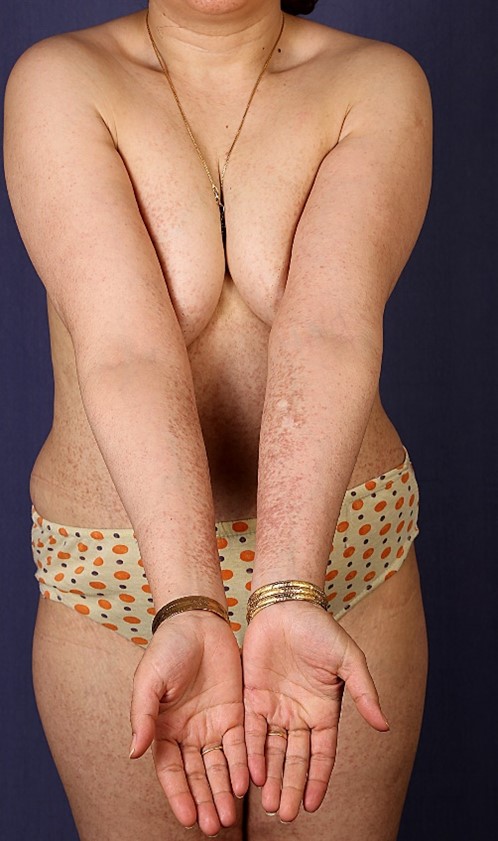
Figure 1: Skin colored to brownish papules on abdomen, arms and forearms with involvement of flexors and extensors.
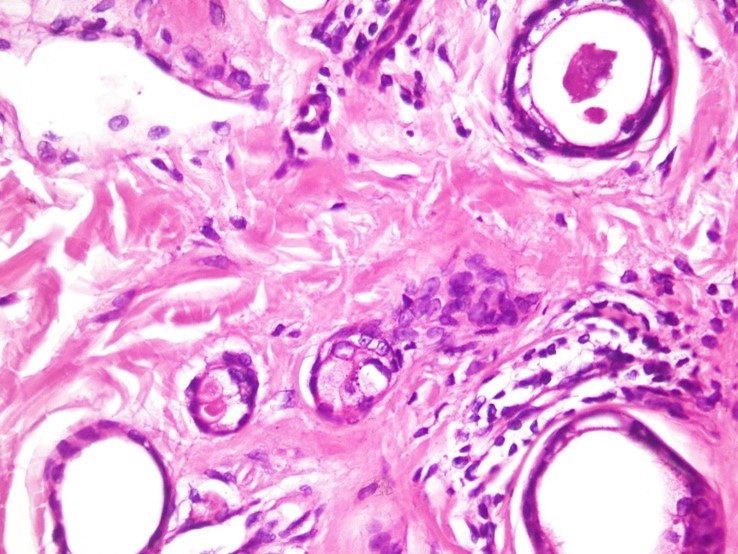
Figure 2: Biopsy specimen from a trunk lesion. some ducts and small cysts and strands of epithelial cells lined by flat or cuboidal cells and filled with homogenous material in the dermis. (Original magnifications ×10).
Discussion
Syringoma is a benign adnexal tumor that originates from the intraepidermal portion of eccrine sweat ducts. Friedman and Butler proposed a syringoma classification criterion based on clinical features and consists of four variants: localized, familial, a form associated with Down syndrome, and a generalized variant which includes multiple and eruptive syringomas, the rarest form among all [6]. The pathophysiology of eruptive syringomas is still ambiguous. Some suggested hormonal influences to be a major cause, while others speculated inflammatory triggers in response to traumas and immune conditions.
Syringomas are known to be benign lesions, and no comorbidity has been reported up-to-date except for being aesthetically disfiguring, and most patients present seeking cosmetical solutions for their cases.
Our case was interesting because it showed features of acral and generalized eruptive syringoma where flexor and extensor surfaces were involved.
Different treatment modalities have been suggested such as surgical excision, dermabrasion, cryotherapy, electrocautery, trichloroacetic acid, carbon dioxide laser ablation and oral and topical retinoids. However, success rates were variable. Oral isotretinoin have been used and reported with variable success. Our patient was treated with oral retinoids, 20 mg of isotretinoin twice a week for 12 weeks with no significant improvement. It is important to keep searching for the reasons behind eruptive syringoma and working on new treatment modalities because it is a distressing condition and has a huge psychological impact on patients.
We discussed this case due to the rarity of eruptive syringomas, and to emphasize that they must be considered in the differential diagnosis of eruptive papular dermatosis at any age.
-A written patient inform consent has been signed and collected from the patient before submission.
-There is no conflict of interest to be mentioned.
-The study received no funds
Authors’ contributions:
Marwa Akhdar: writing the manuscript, reviewing literature, following up patients and correspondence Amirhoushang Ehsani , Zeinab Gholibeigian: revising, consulting, gathering data and patients’ inform consent and photographs; Zahra Razavi supervision, manuscript preparation, revision.
Rokhsare Yadegar: revising and pathology reporting.
All of the authors reviewed the manuscript and approved the final version.
Acknowledgments: We would also like to express our gratitude to all the members of our research team, who provided valuable input, insights, and assistance at every stage of the project.
References
- Jamalipour M, Heidarpour M, Rajabi P. Generalized eruptive syringomas. Indian journal of dermatology, 2009; 54(1): 65-67.
- Korekawa A, Nakajima K, Nishikawa Y, Matsuzaki Y, Nakano H, Sawamura D. Late-onset, eruptive syringoma in an elderly man: correlation with carbamazepine. Acta dermato-venereologica, 2012; 92(1): 87-88.
- Ong GC, Lim KS, Chian LY. Eruptive syringoma in a patient with trisomy 21. Singapore medical journal, 2010; 51(2): e46-47.
- Teixeira M, Ferreira M, Machado S, Alves R, Selores M. Eruptive syringomas. Dermatology online journal, 2005; 11(3): 34.
- Tsunemi Y, Ihn H, Saeki H, Tamaki K. Generalized eruptive syringoma. Pediatric dermatology, 2005; 22(5): 492-493.
- Friedman SJ, Butler DF. Syringoma presenting as milia. Journal of the American Academy of Dermatology, 1987; 16(2 Pt 1): 310-314.