
Email id: info@ijclinmedcasereports.com
Benefit of Intraoperative ICG Imaging in Identifying the Biliary Anatomy During Laparoscopic Cholecystectomy in a Case of Gallbladder Duplication
Lanz D*, Matz D and Heizmann O
Department of Surgery, Agaplesion Diakonieklinikum Rotenburg, Germany
Received Date: 09/04/2025; Published Date: 07/07/2025
*Corresponding author: Lanz D, Department of Surgery, Agaplesion Diakonieklinikum Rotenburg, Germany
Abstract
Gallbladder duplication is a rare congenital biliary malformation associated with an elevated risk of biliary injuries during cholecystectomy. It is therefore of utmost importance to clearly identify the anatomical structures. Intraoperative fluorescence imaging has been used for intraoperative imaging of the biliary ducts. Our case shows that intraoperative imaging with indocyanine green (ICG) is a helpful tool to ease intraoperative identification of the biliary anatomy in gallbladder duplication, contributing to better intraoperative decisions and the safety of the procedure.
Keywords: Gallbladder duplication; Double gallbladder; Laparoscopic cholecystectomy; ICG imaging; Indocyanine green; Fluorescent choliangiography; Biliary anatomy; Case report
Introduction
Gallbladder duplication is a rare congenital biliary malformation. It is associated with an elevated risk of biliary injuries during cholecystectomy or other operations and interventions involving the biliary ducts [1]. The present case report details a patient with type 2 gallbladder duplication, as defined by the Harlaftis classification [2], who underwent a cholecystectomy with intraoperative fluorescence imaging to enhance cystic duct visibility.
Case Report
The 60-year-old Caucasian man presented with symptomatic cholelithiasis. Over the years, he had been hospitalized multiple times for recurrent cholecystitis. During routine work ups a gallbladder anomaly was suspected, after which a gallbladder duplication type 2 (characterized by double cystic ducts in the Harlaftis classification) was diagnosed and followed up with multiple MRCP studies. The two gall bladders lay in the gallbladder fossa, with individual cystic ducts entering the common bile duct. Only one gall bladder showed stones and signs of chronic cholecystitis.
We planned an elective laparoscopic surgery for the removal of both gall bladders, to mitigate the risk of future interventions. The patient received indocyanine green (ICG) 45 minutes before surgery. This enabled intraoperative fluorescence imaging with clear identification of both the cystic ducts, as well as the common bile duct in the surrounding tissue of the Calot triangle. The gall bladders were removed together, the two cystic ducts and the single cystic artery each clipped individually. The patient recovered well and was discharged on the second postoperative day as this is routine in our clinic. Pathohistology confirmed the presence of two gallbladders, with signs of chronic cholecystitis in both.
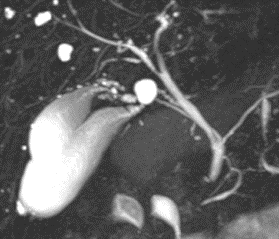
Figure 1: MRCP of double gallbladder with two cystic ducts.
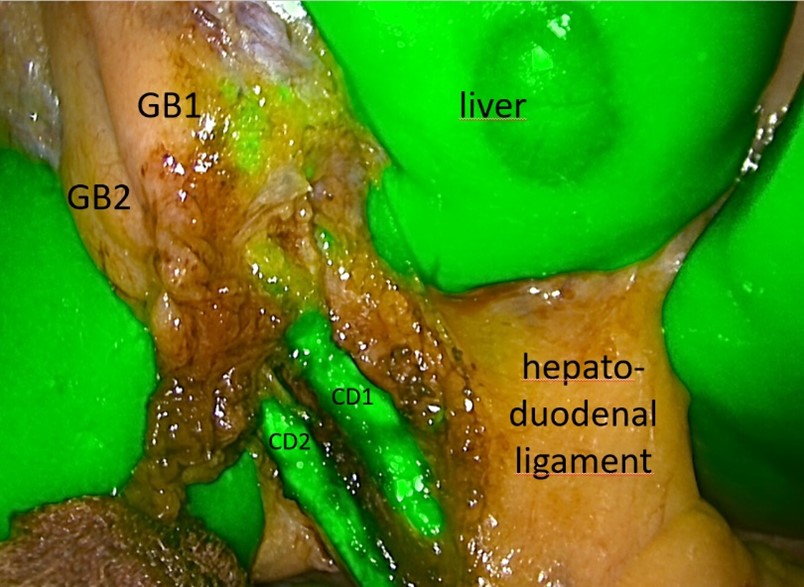
Figure 2: Intraoperative View of double gallbladder (GB1 and GB2) with separate cystic ducts (CD1 and CD2).
Discussion
Gallbladder duplication is a rare biliary malformation associated with a higher risk of biliary injuries during cholecystectomy. There are multiple publications describing this difficulty and emphasizing the importance of clarifying the anatomical structures [1,3]. There have been individual reports on the use of ICG for intraoperative imaging of the biliary ducts [4]. Our case clearly confirms that intraoperative fluorescence imaging is a helpful tool to ease intraoperative identification of the biliary anatomy, contributing to better intraoperative decisions and the safety of the procedure.
References
- Darnis Benjamin, Mohkam Kayvan, Cauchy François, Cazauran Jean-Baptiste, Bancel Brigitte, Rode Agnès, et al. A systematic review of the anatomical findings of multiple gallbladders. HPB, 2018; 20. 10.1016/j.hpb.2018.04.002.
- Harlaftis N, Gray SW, Skandalakis JE. Multiple gallbladders. Surg Gynecol Obstet, 1977; 145: 928-934.
- Musleh MG, Burnett H, Rajashanker B, Ammori BJ. Laparoscopic double cholecystectomy for duplicated gallbladder: A case report. Int J Surg Case Rep, 2017; 41: 502-504. doi: 10.1016/j.ijscr.2017.11.046.
- Ankersmit M, van Dam DA, van Rijswijk A-S, van den Heuvel B, Tuynman JB, Meijerink WJHJ. Fluorescent Imaging With Indocyanine Green During Laparoscopic Cholecystectomy in Patients at Increased Risk of Bile Duct Injury. Surgical Innovation, 2017; 24(3): 245-252. doi:10.1177/1553350617690309.