
Email id: info@ijclinmedcasereports.com
Poland Syndrome: A Rare Chest Wall Disorder
Doaae El Ouaddane1,*, Sara Zarrouki1, Ahmed Ahddadi1, Akram Assadiki1, Badie Douqchi2, Salima Hamraoui1 and Rachid Marouf1
1Departement of thoracic surgery, Mohammed VI University Hospital, Faculty of Medicine and Pharmacy, Mohammed First University, Morocco
2Department of Anesthesia and Reanimation, Mohammed VI University Hospital, Faculty of Medicine and Pharmacy, Mohammed First University, Morocco
Received Date: 28/05/2025; Published Date: 30/06/2025
*Corresponding author: Doaae El Ouaddane, Departement of thoracic surgery, Mohammed VI University Hospital, Faculty of Medicine and Pharmacy, Mohammed First University, Oujda, Morocco
Abstract
Poland syndrome is a rare congenital malformation involving varying degrees of thoracic and ipsilateral upper limb anomalies. We report the case of a 19-year-old man, investigated for depression of the left hemithorax. Computed tomography showed that the chest wall deformation was related to the absence of the sternocostal insertion heads of the left pectoralis major muscle with agenesis of the pectoralis minor and hypoplasia of the anterior arches of the corresponding first six ribs. These anomalies were attributed to Poland syndrome. A general assessment consisting of abdominal ultrasound and X-rays of both hands was carried out on the patient and revealed no associated malformation. Poland syndrome results from a defect in the blood supply to the musculoskeletal elements of the chest wall during fetal life. There are many variants of Poland syndrome that can be best detected by CT, which should be performed whenever available, without omitting the role of general radiology in detecting associated malformations. The characteristic feature of this syndrome is agenesis of the sternocostal bundles of the pectoralis major muscle. Its etiology remains unknown and debated. A vascular anomaly would be the cause, without the primum movens of this vascular anomaly being known.
Introduction
Poland syndrome is characterized by agenesis of the pectoralis major muscle and mammary agenesis associated or not with anomalies of the homolateral upper limb [1–3]. The complete form associate’s agenesis of the sternocostal bundles of the pectoralis major with symbrachydactyly of the homolateral hand. This malformation owes its name to Alfred Poland, an anatomy student, who was the first to give a complete description of it in 1841 [4,5]. Thoracic anomalies are muscular, osteocartilaginous and cutaneous-glandular [5]. In rare, severely affected cases, abnormalities of internal organs such as the lungs, kidneys and heart may be associated [1,3,4]. The right side is affected in 75% of cases [1]. The cause of Poland syndrome remains unknown [1,5,6]. The hypothesis of interruption of blood flow during fetal development could explain the agenesis of the pectoralis major muscle [1,4,5].
Case Report
We report the case of a 19-year-old Man, born at term, with no evidence of consanguinity or medication taken during gestation. Presents with left thoracic depression affecting his quality of life without functional impairment. Physical examination revealed depression of the left chest wall responsible for asymmetry of the two hemithoraxes (Figures 1,2). The neurological and skeletal examination was normal. A thoracic CT scan was performed, revealing agenesis of the sternocostal insertion portion of the left pectoralis major with total agenesis of the pectoralis minor and hypoplasia of the anterior arches of the first six homolateral ribs (Figure 3) corresponding to Poland syndrome. A malformation assessment using abdominal ultrasound and X-rays of both hands was carried out, revealing no associated malformation, particularly renal and upper limb bones.
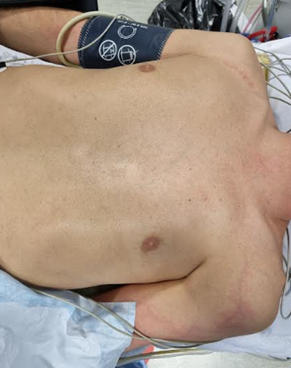
Figure 1: Clinical appearance of the patient with Poland syndrome; absence of the left pectoralis major.
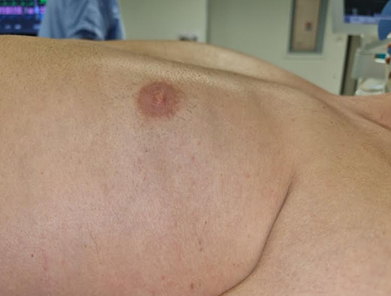
Figure 2: Depression of the left pectoral region.
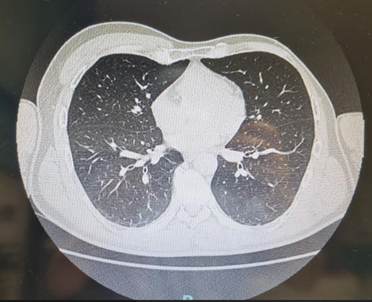
Figure 3: Axial computed tomographic images of the thorax showing: hypoplasia of the left pectoralis major muscle with absence of the heads with sternocostal insertion.
Discussion
Poland syndrome is a rare congenital anomaly involving musculoskeletal malformations of the chest wall and ipsilateral upper limb [1–3]. It was first described by Sir Alfred Poland in 1841 [7]. It is of unknown etiology. Many theories have been proposed, but it seems that the interruption of embryonic blood supply to the subclavian artery, vertebral arteries and their branches, explains the occurrence of Poland syndrome and its variants [7, 8]. This condition usually occurs during the sixth week of gestation [7]. These vascular disturbances can also explain the appearance of other syndromes such as Möbius, Klippel-Feil and Adams-Oliver [7]. Other studies have implicated exposure to ergot alkaloids during the first trimester of pregnancy in the onset of the syndrome [7]. Since then, numerous variants and abnormalities associated with this syndrome have been described [9]. These include absence of the pectoralis minor or complete absence of both pectoral muscles, rib hypoplasia, hypoplasia of the scapula and its muscles, or even rare manifestations such as dextrocardia [3], renal agenesis, pneumothorax on the affected side [4], shoulder dislocation, abnormal hemostatic assessment and thrombocytopenia, growth hormone deficiency [7] or facial nerve paralysis [10]. In this observation, we report the case of a patient with the clinical criteria for Poland syndrome, confirmed by a CT scan, which is the examination of choice that can reveal all the anomalies described in this syndrome [5, 7]; it allows the assessment of muscular hypoplasia, in particular for the latissimus dorsi, but also the associated bone anomalies of the thoracic cage (pectus excavatum or associated carinatum) more precisely than chest X-ray. CT then provides additional assistance to clinicians to make the diagnosis more easily and to plastic surgeons to be aware of the exact abnormalities and proceed with surgical reconstruction. Mammography is routinely performed in adult women after 30 years of age, given that the association of Poland syndrome and breast neoplastic disease has been widely discussed [11]. In this reported case, we did not note any associated malformations of the upper limbs, which occur only in 12% of patients with Poland syndrome. But mild cases of Poland syndrome without upper limb involvement may not be evident until puberty, when the differences between the two sides become more apparent [1]. The disease causes alteration of the patient's body image, particularly in female patients, with the associated risk of mammary agenesis [7]. According to the literature, Poland syndrome has many clinical presentations. It could be difficult to diagnose for clinicians and plastic surgeons [7]. Treatment of these anomalies is based on surgical reconstruction, which should be performed from the age of 13-14 years in male patients with an intact latissimus dorsi [7]. The latter is usually harvested through a small dorsal and axillary incision and transposed to fill the void due to the absence of the pectoralis major muscle. Prosthesis reconstruction has been described for men, but the results are generally disappointing [12]. In women, as in men, abnormal development of the mammary gland can cause aesthetic and therefore psychological damage, early treatment can then be considered [7].
Conflict of Interest: The authors declared that they have no conflict of interest.
Grant Information: The author(s) received no specific funding for this work.
Acknowledgement: The authors have no acknowledgements to declare.
References
- Lee SH, Kim JB, Park NH, Keum DY, Kim YH. Rare combination of dextrocardia with right-sided Poland syndrome. Ann Thorac Surg, 2012; 94(4): e103-e104. doi: 10.1016/j.athoracsur.2012.03.106.
- Urschel HC Jr. Poland syndrome. Semin Thorac Cardiovasc Surg, 2009; 21(1): 89-94. doi: 10.1053/j.semtcvs.2009.03.004.
- Yiyit N, Isitmangil T, Oksuz S. Clinical analysis of 113 patients with Poland syndrome. Ann Thorac Surg, 2015; 99(3): 999-1004. doi: 10.1016/j.athoracsur.2014.10.036.
- Chowdhury MK, Chakrabortty R, Gope S. Poland's syndrome: a case report and review of literature. J Pak Med Assoc, 2015; 65(1): 87-89.
- Ibrahim A, Ramatu A, Helen A. Poland syndrome a rare congenital anomaly. Indian J Hum Genet, 2013; 19(3): 349-351.
- Rosa RF, Travi GM, Valiatti F, Zen PR, Pinto LL, Kiss A, et al. Poland syndrome associated with an aberrant subclavian artery and vascular abnormalities of the retina in a child exposed to misoprostol during pregnancy. Birth Defects Res A Clin Mol Teratol, 2007; 79(6): 507-511.
- David TJ. Familial Poland anomaly. J Med Genet, 1982; 19(4): 293-296.
- Ram AN, Chung KC. Poland's syndrome: current thoughts in the setting of a controversy. Plast Reconstr Surg, 2009; 123(3): 949-953.
- Bavinck JN, Weaver DD. Subclavian artery supply disruption sequence: hypothesis of a vascular etiology for Poland, Klippel-Feil, and Möbius anomalies. Am J Med Genet, 1986; 23(4): 903-918.
- Gui L, Shen S, Mei W. Anaesthesia for chest wall reconstruction in a patient with Poland syndrome: CARE-compliant case report and literature review. BMC Anesthesiol, 2018; 18(1): 57.