
Email id: info@ijclinmedcasereports.com
Spinal Aneurysmal Bone Cyst
Dehayni Fariss*, Neftah Ismail, Handi Omar, Belkouchi Lina, El Haddad Siham, Allali Nazik and Chat Latifa
Department of Radiology, Children Hospital of Rabat, Faculty of Medicine and Pharmacy of Rabat, Morocco
Received Date: 08/04/2025; Published Date: 27/06/2025
*Corresponding author: Dehayni Fariss, Department of Radiology, Children Hospital of Rabat, Faculty of Medicine and Pharmacy of Rabat, Morocco
Case Description
A 13 years old female admitted in pediatric consultation for pain and chronic swelling of the spinal region, paresthesia of lower limb.
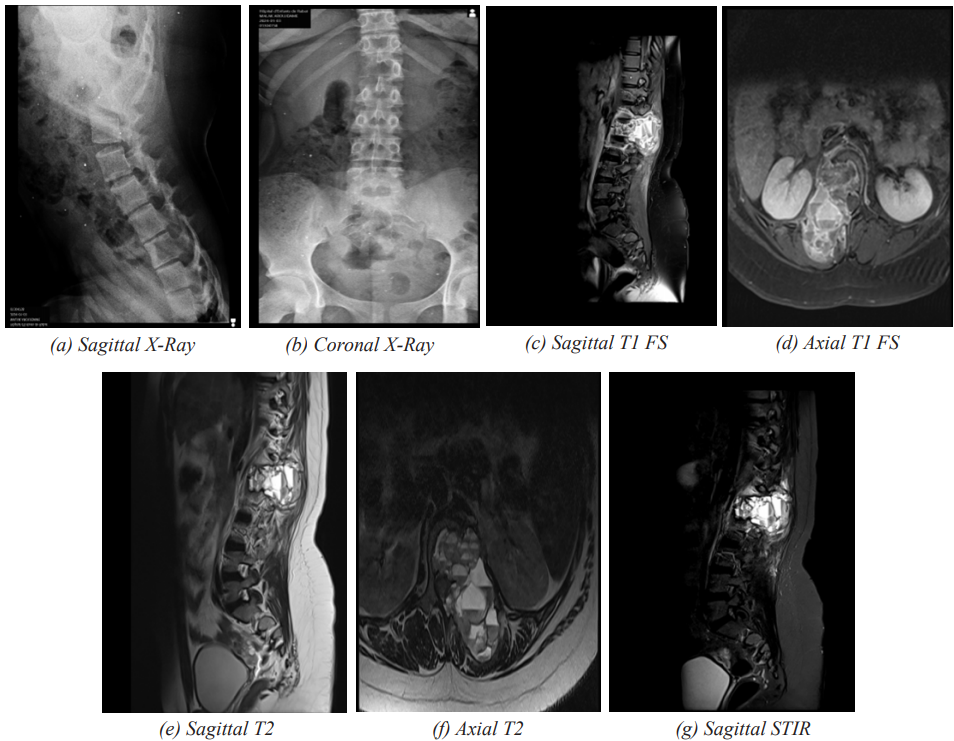
A first radiographic was performed showing a sharply defined solitary bone lesion at the level of D11- D12 (a,b).
In front of the persistence of the symptoms, an MRI was performed and the findings were very characteristics of Aneurysmal bone cyst, revealing a cystic bone mass of the vertebral body and the right transverse processes of D11-D12 and L1, with a fluid-fluid level extending to the vertebral canal anteriorly, and posteriorly to right dorsal muscles, it appears in hypersignal T1 fat sat (c,d) and T2 (e,f), hypersignal STIR (g).
Discussion
Aneurysmal bone cyst (ABC) is a descriptive composed of two terms: “Aneurysmal” which means expansion and the word “cyst” which means cavities, the particularity of this cavities is the presence of a “fluid-fluid” level.” However, it is neither an aneurysm nor a cyst, but a true neoplasm.
ABC is a rare tumor which account of 1% of all bone tumors with an incidence of 0.14 per 100,000 individuals and a prevalence of 0.32 cases per 100,000 individuals. The vast majority of ABC occurs in children and young individuals, and has a male to female ratio of 1:1.16 [1]
The classic presentation includes pain and swelling, a palpable masse, paresthesia and scoliosis in spinal location. it can be revealed by a pathological fracture in rare cases.
On radiographs features, ABC is shown as are lytic, expansile, geographical, lobulated, metaphyseal-based lesions and have a distinct sclerotic border, it has septations that can or cannot be seen on this imaging modality. Different types of periosteal reaction may be seen [2,3].
MRI is the diagnostic modality of choice for the diagnosis of ABC by showing the internal composition of the cystic lesion with the pathognomonic “fluid-fluid” level, the evidence of the septations, and the nodularity enhancement; the extension of the lesion (physical, epiphyseal, soft tissue and vertebral canal extension), and the evidence of perilesional oedema [4].
Treatment
The treatment of choice in spinal ABCs is the Surgical “en bloc” resection, other alternative is a preoperative angiography and embolization to minimize the risk of bleeding.
References
- Cottalorda J, Kohler R, Sales de Gauzy J, et al. Epidemiol- ogy of aneurysmal bone cyst in children: a multicenter study and literature review. J Pediatr Orthop B, 2004; 13: 389–394.
- Mascard E, Gomez-Brouchet A, Lambot K. Bone cysts: unicameral and aneurysmal bone cyst. Orthop Traumatol Surg Res, 2015; 101: S119–S127.
- Rapp TB, Ward JP, Alaia MJ. Aneurysmal bone cyst. J Am Acad Orthop Surg, 2012; 20: 233–241.
- Zishan US, Pressney I, Khoo M, Saifuddin A. The differentiation between aneurysmal bone cyst and telangiectatic osteosarcoma: a clinical, radiographic and MRI study. Skeletal Radiol, 2020; 49: 1375–1386.