
Email id: info@ijclinmedcasereports.com
Experience with Handgrip Isometric Exercise in Elderly and Senile Patients in a Hospital Setting
Gulnora Rozikhodjaeva1,2,* and Manzura Rakhimova1
¹Department of Functional Diagnostics, Central Clinical Hospital No. 1 of the Head Medical Department under the Administration of the President of the Republic of Uzbekistan
²Department of Ultrasound Diagnostics, Center for the Development of Professional Qualifications of Medical Workers, Tashkent, Uzbekistan
Received Date: 12/05/2025; Published Date: 24/06/2025
*Corresponding author: Doctor of Medical Sciences, Professor Gulnora Rozikhodjaeva, Head of the Department of Functional Diagnostics, Central Clinical Hospital№1 of the Head Medical Department under the Administration of the President of the Republic of Uzbekistan, Tashkent, Uzbekistan
Abstract
Aging is accompanied by significant cardiovascular alterations, including impaired diastolic function and increased risk of heart failure. Doppler echocardiography, including tissue Doppler imaging (TDI), provides a noninvasive approach to assess transmitral flow and myocardial motion, making it particularly relevant for elderly populations. This study aimed to evaluate the effects of isometric handgrip exercise on left ventricular (LV) filling parameters in older adults using pulsed Doppler and TDI techniques. The findings underscore the clinical utility of comprehensive Doppler echocardiography for early detection of diastolic dysfunction, risk stratification, and therapy monitoring in older adults.
Keywords: Elderly and senile patients; Doppler echocardiography; Tissue Doppler imaging; Diastolic function
Introduction
Aging is associated with structural and functional cardiovascular changes, including decreased myocardial elasticity, impaired diastolic relaxation, and elevated risks of heart failure and hypertension. Doppler echocardiography, particularly with tissue Doppler imaging, offers a highly informative noninvasive diagnostic tool. Measurements such as the early-to-late filing ratio (E/A) and tissue Doppler parameters (e′, a′, e′/a′, E/e′) allow early detection of subclinical dysfunction prior to overt heart failure [1,2].
Recent studies from the past 5–10 years demonstrate that TDI metrics correlate with clinical prognosis in heart failure, aiding therapeutic decisions [3,4]. Doppler parameters also serve as monitoring tools for treatment responses, particularly relevant in elderly patients at higher risk for complications [5–7].
Comprehensive cardiac evaluation using spectral and tissue Doppler thus holds significant clinical value for early diagnosis, risk prediction, and personalized therapy in elderly populations.
Aim and Objective
- To determine the impact of isometric handgrip exercise on the LV filling pattern in elderly and senile patients using pulsed-wave and tissue Doppler echocardiography
- To explore associations between hemodynamic changes and clinical characteristics.
Materials and Methodology
A total of 170 inpatients were examined, of whom 99 elderly and senile patients with ischemic heart disease (mean age 74 years) were referred to the functional diagnostics department of Central Clinical Hospital No. 1. A comprehensive clinical assessment was performed, including chest X-ray, complete blood and urine analysis, biochemical panel, coagulation profile, ECG, stress ECG, heart rate variability analysis, transthoracic echocardiography, Isometric Handgrip Exercise (IHE), stress echocardiography with IHE, and duplex scanning of the carotid arteries. Comorbidities were documented.
Diastolic function was assessed using pulsed-wave Doppler (E, A, E/A ratio), stroke volume, end-diastolic volume, LV mass index, and TDI parameters (e′, a′, e′/a′, E/e′). Measurements were taken at rest and during IHE using an electronic hand dynamometer (EH 101 CAMRY). Load intensity was set at 40% of maximal voluntary contraction measured during pre-testing. Echocardiographic imaging was performed during 3 minutes of continuous handgrip to monitor both transmitral flow and TDI changes.
Results
Dynamic responses of echocardiographic indices to IHE were analyzed to identify factors most significantly affecting transmitral flow and myocardial function under stress. Correlation analysis was conducted to assess associations between echocardiographic parameters and patient characteristics (age, heart rate, septal thickness, LV mass index).
Baseline Characteristics of the Study Population are presented in Table1.
Table 1: Baseline Characteristics of the Study Population (n = 99).
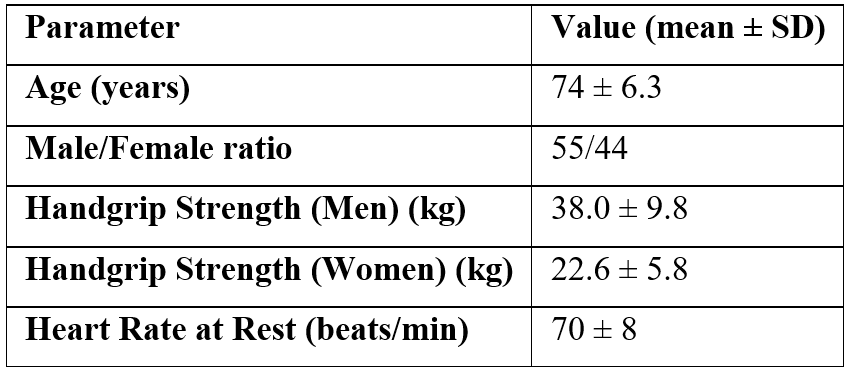
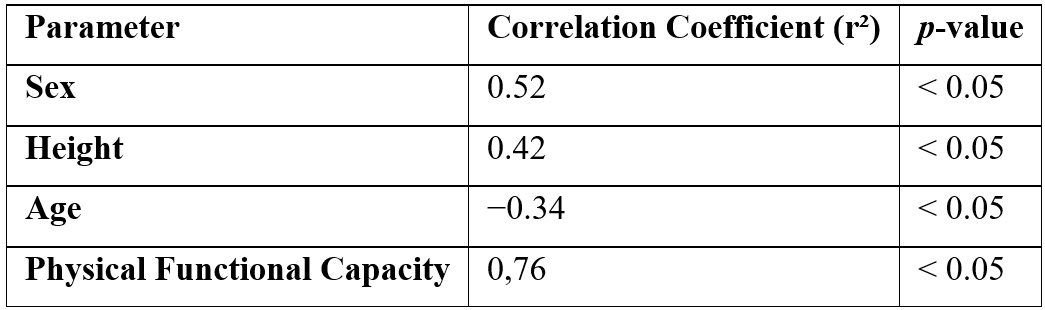
Handgrip strength was significantly greater in men than in women (38 ± 9.8 kg vs. 22.6 ± 5.8 kg, p <0.05), but declined with age in both sexes. The strongest correlates of maximal handgrip strength were sex (r² = 0.52, p <0.05), height (r² = 0.42, p <0.05), and age (r² = −0.34, p <0.05). Baseline strength was associated with physical functional capacity in individuals over 60 years of age. Increased grip strength correlated with higher functional class (r² = 0.76, p <0.05). (Table 2)
Table 2: Correlation of Maximal Handgrip Strength with Clinical Parameters.
At rest, typical signs of diastolic dysfunction included decreased E/A ratio, increased A velocity, and moderate reduction in e′ and e′/a′.
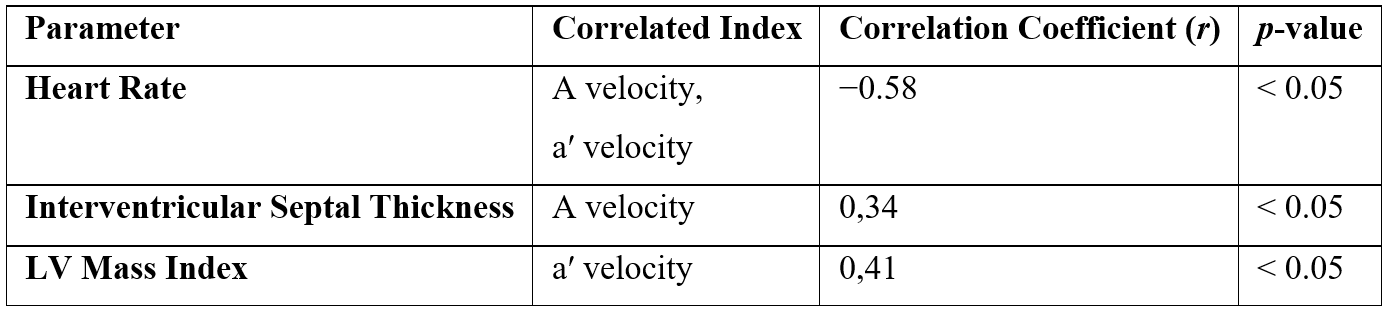
During IHE, significant increases in A and a′ were observed, indicating augmented atrial contribution to LV filling. These changes correlated with heart rate (r = −0.58, p <0.05), septal thickness, and LV mass index. (Table 3).
Table 3: Changes in Echocardiographic Parameters at Rest and During IHE.
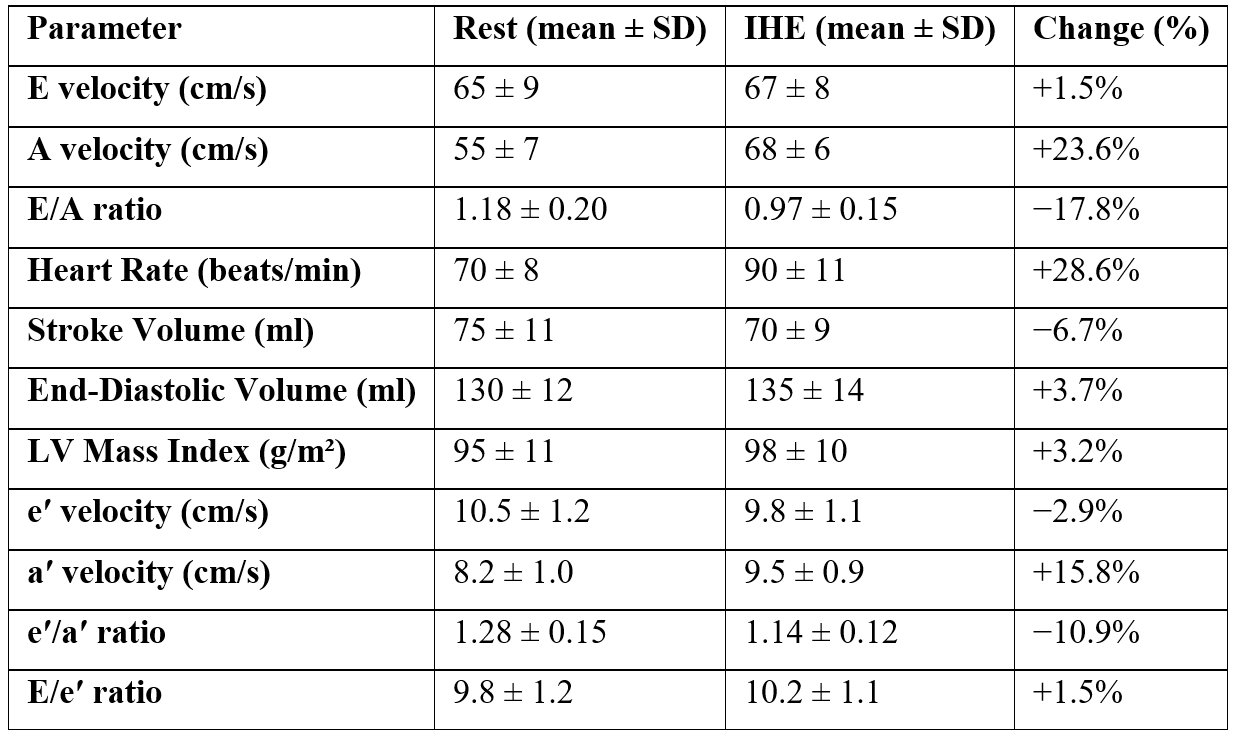
At rest, a reduced E/A ratio and elevated A and a′ values reflect increased atrial contribution to LV filling. Tissue Doppler parameters (e′, a′, E/e′) demonstrated changes under stress, suggesting compensatory myocardial involvement. Changes in echocardiographic parameters correlated with heart rate, septal thickness, and LV mass index, supporting their clinical relevance (Table 4).
Table 4: Correlation of Hemodynamic Changes During IHE with Structural and Functional Parameters.
Our findings align with recent studies [6–8] indicating that combined conventional and tissue Doppler assessment allows more precise evaluation of diastolic dysfunction severity and heart failure risk in elderly patients.
Conclusion
Integrating spectral and tissue Doppler modalities enhances early detection of subclinical diastolic dysfunction and facilitates heart failure risk stratification, supporting timely therapeutic adjustments in elderly patients.
References
- Miroshnikov AB, Smolensky AV. The effect of isometric training on blood pressure: a systematic review. Vopr Kurortol Fizioter Lech Fiz Kult, 2023; 100(4): 46–53.
- Baevsky RM. Diagnostic value of psycho-emotional and isometric handgrip stress tests. Vestnik Nov Med Tekhnol, 2019; 26(1): 22–27.
- Ivanov SV, Petrov AN. Effects of isometric loading in healthy individuals and various pathologies. Lesgaft Univ Bull, 2020; 182(4): 123–128.
- Rozikhodjaeva GA. Functional state of the cardiovascular system in elderly IHD patients. Doctoral Dissertation Abstract. Tashkent, 2006.
- Rozikhodjaeva GA, Aitimova G Yu, Juraev OR. Independent correlates of walking distance in the elderly. Science and Medicine, 2018; 4: 269–270.
- Nagueh SF, et al. Recommendations for evaluation of LV diastolic function. J Am Soc Echocardiogr, 2016; 29(4): 277–314.
- Andersen OS, et al. Estimating LV filling pressure by echocardiography. J Am Coll Cardiol, 2017; 69(15): 1937–1948.
- Lancellotti P, et al. Tissue Doppler imaging in myocardial performance. Eur Heart J Cardiovasc Imaging, 2018; 19(3): 223–232.